Reaction equation

[Br:1][C:2]1[CH:3]=[CH:4][C:5]([F:28])=[C:6]([CH:8]([C:10]2[CH:15]=[CH:14][C:13]([C:16]#[C:17][Si:18]([CH:25]([CH3:27])[CH3:26])([CH:22]([CH3:24])[CH3:23])[CH:19]([CH3:21])[CH3:20])=[CH:12][CH:11]=2)O)[CH:7]=1.C([SiH](CC)CC)C.FC(F)(F)C(O)=O>ClCCl>[Br:1][C:2]1[CH:3]=[CH:4][C:5]([F:28])=[C:6]([CH:7]=1)[CH2:8][C:10]1[CH:15]=[CH:14][C:13]([C:16]#[C:17][Si:18]([CH:25]([CH3:27])[CH3:26])([CH:22]([CH3:23])[CH3:24])[CH:19]([CH3:20])[CH3:21])=[CH:12][CH:11]=1Participants
5
Reactant 3

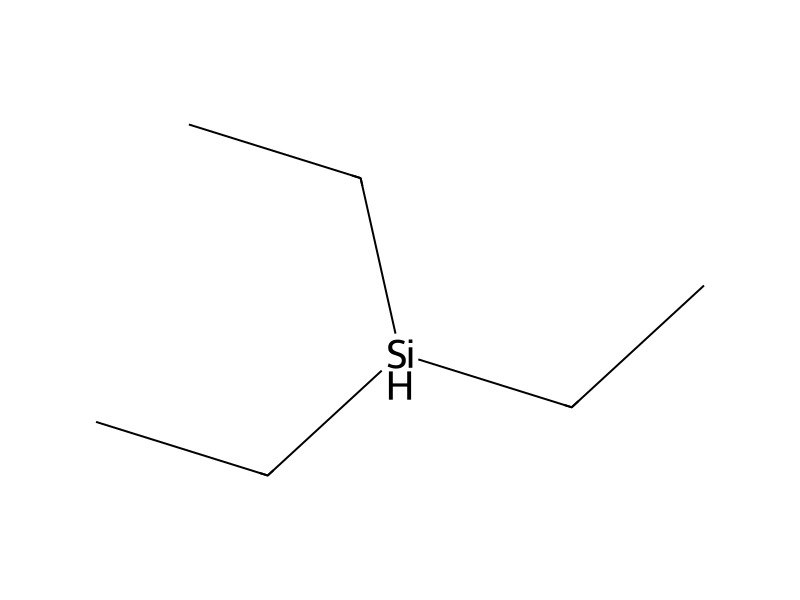

Product 1

Reagents, catalysts & solvents 1

Procedure
A solution of 5.6 g (5-bromo-2-fluoro-phenyl)-{4-[(triisopropylsilyl)-ethynyl]-phenyl}-methanol and 4.1 ml triethylsilane in 50 ml dichloromethane is cooled in the ice bath. Then 4.7 ml trifluoroacetic acid are slowly added dropwise, and the solution is stirred for 4 h at ambient temperature. The solution is diluted with dichloromethane and washed with aqueous sodium hydrogen carbonate solution. After drying over sodium sulphate the solvent is removed and the residue is purified using silica gel (cyclohexane).
Workup
- washwashed with aqueous sodium hydrogen carbonate solution
- dry with materialAfter drying over sodium sulphate the solvent
- customis removed
- customthe residue is purified
Sources & evidence
- ORD record
- ord-ab68764deff8446f9dc887ef2fccc268
- Source dataset
- uspto-grants-2009_08
- Patent number
- US07579449B2
Linked notes
Loading…