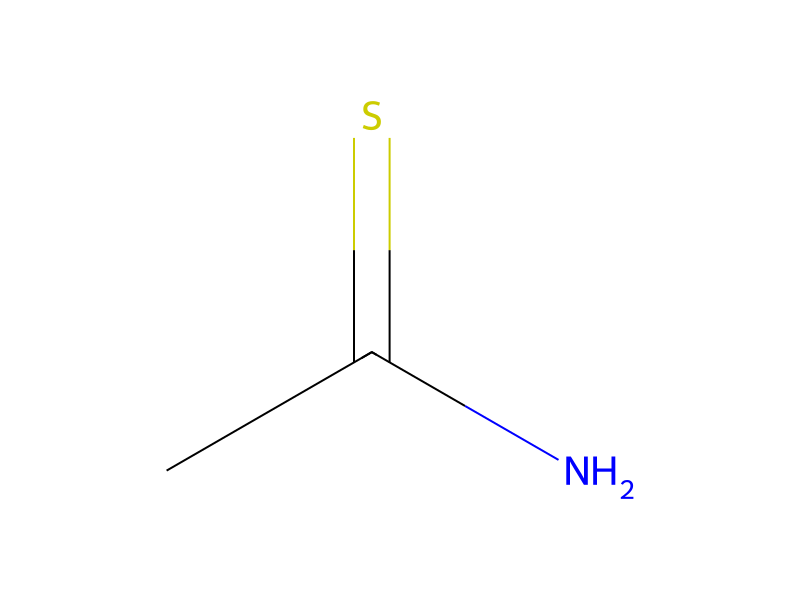
Thioacetamide → 7-bromo-4-(2-methyl-1,3-thiazol-4-yl)-2H-chromen-2-one
Reaction equation

[Br:1][C:2]1[CH:11]=[C:10]2[C:5]([C:6]([C:13](=O)[CH2:14]Br)=[CH:7][C:8](=[O:12])[O:9]2)=[CH:4][CH:3]=1.[C:17]([NH2:20])(=[S:19])[CH3:18]>CN(C=O)C>[Br:1][C:2]1[CH:11]=[C:10]2[C:5]([C:6]([C:13]3[N:20]=[C:17]([CH3:18])[S:19][CH:14]=3)=[CH:7][C:8](=[O:12])[O:9]2)=[CH:4][CH:3]=1Participants
4
Reactant 2

Product 1

Reagents, catalysts & solvents 1

Conditions
- Temperature
- 100 °C
Procedure
To a solution of 7-bromo-4-(bromoacetyl)-2H-chromen-2-one (0.605 g, 1.7 mmol) in DMF was added thioacetamide (0.138 g, 1.8 mmol). The mixture was stirred 24 h at rt and at 100° C. overnight. Once cool to rt, it was partitioned between aqueous NH4Cl and EtOAc. The layers were separated and the aqueous phase was extracted with EtOAc. The combined organic layers were washed with brine and dried over anhydrous Na2SO4. The solvent was evaporated and the residue swished in hexanes/Et2O to give the title compound.
Workup
- temperatureOnce cool to rt
- customit was partitioned between aqueous NH4Cl and EtOAc
- customThe layers were separated
- extractionthe aqueous phase was extracted with EtOAc
- washThe combined organic layers were washed with brine
- dry with materialdried over anhydrous Na2SO4
- customThe solvent was evaporated
Sources & evidence
- ORD record
- ord-c33af81955c0450cb8ae90c00e01350a
- Source dataset
- uspto-grants-2008_10
- Patent number
- US07439260B2
Reaction notes
Loading…