Reaction equation
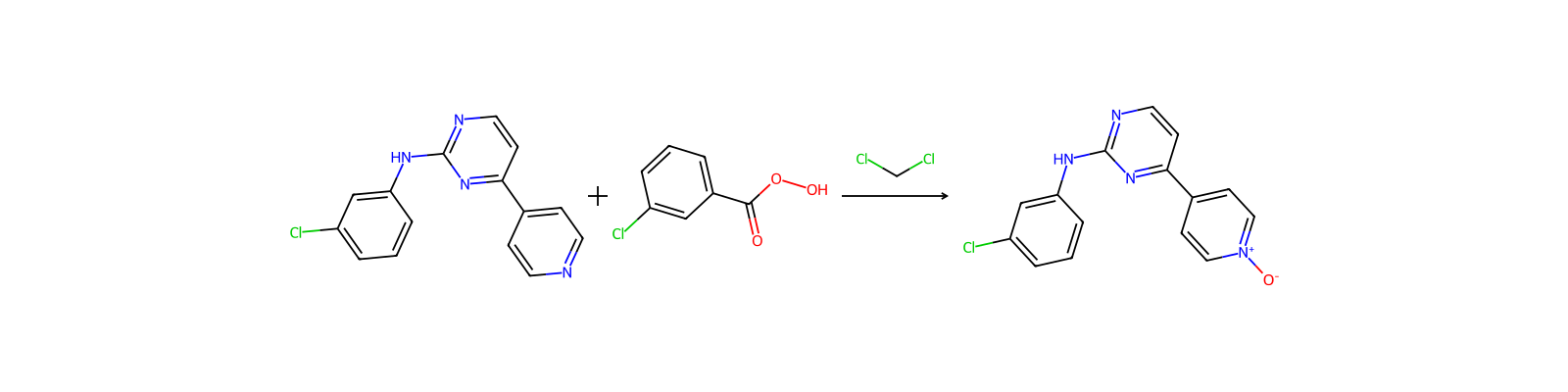
[Cl:1][C:2]1[CH:3]=[C:4]([NH:8][C:9]2[N:14]=[C:13]([C:15]3[CH:20]=[CH:19][N:18]=[CH:17][CH:16]=3)[CH:12]=[CH:11][N:10]=2)[CH:5]=[CH:6][CH:7]=1.ClC1C=CC=C(C(OO)=[O:29])C=1>C(Cl)Cl>[Cl:1][C:2]1[CH:3]=[C:4]([NH:8][C:9]2[N:14]=[C:13]([C:15]3[CH:20]=[CH:19][N+:18]([O-:29])=[CH:17][CH:16]=3)[CH:12]=[CH:11][N:10]=2)[CH:5]=[CH:6][CH:7]=1Participants
4
Reactant 2


Product 1

Reagents, catalysts & solvents 1

Procedure
10 g (35.4 mmol) of N-(3-chloro-phenyl)-4-(4-pyridyl)-2-pyrimidineamine and 11.1 g (35.4 mmol) of m-chloroperbenzoic acid are stirred for 5 h at RT in 500 ml of methylene chloride. Concentration and crystallisation (acetic acid) of the residue give N-(3-chloro-phenyl)-4-(N-oxido4-pyridyl)-2-pyrimidineamine; m.p. 274°-275°, Rf =0.6 (methylene chloride:methanol=9:1).
Workup
- concentrationConcentration and crystallisation (acetic acid) of the residue
Sources & evidence
- ORD record
- ord-a39fc3b67bbd45ff88d29b84e47f577f
- Source dataset
- uspto-grants-1998_03
- Patent number
- US05728708
Linked notes
Loading…