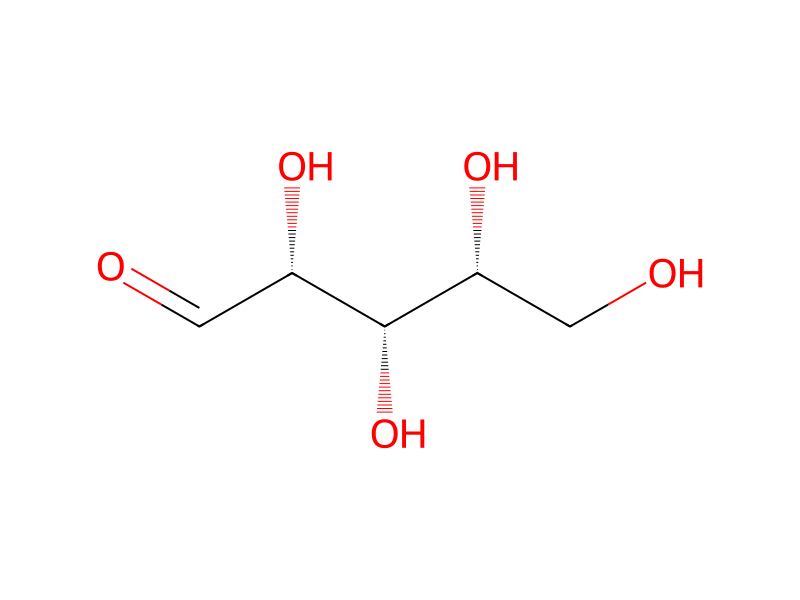
aldehydo-D-Xylose → (2R,3S,4R,5R)-2,3,4,5,6-pentahydroxyhexanal
Reaction equation

O=[C:2]([OH:11])[C@@H:3]([C@H:5]([C@@H:7]([CH2:9][OH:10])[OH:8])[OH:6])[OH:4].[O:12]=[CH:13][C@@H]([C@H]([C@@H](CO)O)O)O>>[O:12]=[CH:13][C@@H:2]([C@H:3]([C@@H:5]([C@@H:7]([CH2:9][OH:10])[OH:8])[OH:6])[OH:4])[OH:11]Participants
3


Procedure
When the P. ananatis NA1 strain was cultured with the mixed carbon source of glucose and xylose (MSII-GX medium), the glutamic acid yield was 25.7% (Table 2). In this case, accumulation of xylonic acid was observed, and thus it was suggested that most of xylose was converted into xylonic acid. It is estimated that the accumulation of xylonic acid with the P. ananatis NA1 strain was provided by the activity of glucose dehydrogenase of P. ananatis.
Sources & evidence
- ORD record
- ord-925f5202b88b4b4ead7ba0e2477d96af
- Source dataset
- uspto-grants-2015_06
- Patent number
- US09045789B2
Reaction notes
Loading…