HomeMCPWorkbenchSkills
HomeWorkbenchNotificationsMe
llms.txt · MCP GuidePrivacy Policy · Terms of Service · Supportv1.8.0
  1. Home
  2. /Reaction

Oxalyl chloride → N-(5-bromopyridin-3-yl)-1-methylpiperidine-4-carboxamide

HRID 2178635
Notes
Print preview

Reaction equation

HRID 2178635 reaction equation
C(Cl)(=O)C(Cl)=O.[CH3:7][N:8]1[CH2:13][CH2:12][CH:11]([C:14]([OH:16])=O)[CH2:10][CH2:9]1.[NH2:17][C:18]1[CH:19]=[N:20][CH:21]=[C:22]([Br:24])[CH:23]=1>CN(C=O)C.C(Cl)Cl>[Br:24][C:22]1[CH:23]=[C:18]([NH:17][C:14]([CH:11]2[CH2:10][CH2:9][N:8]([CH3:7])[CH2:13][CH2:12]2)=[O:16])[CH:19]=[N:20][CH:21]=1
ParticipantsProcedureWorkupSources & evidenceReaction notes

Participants

6

Reactant 3

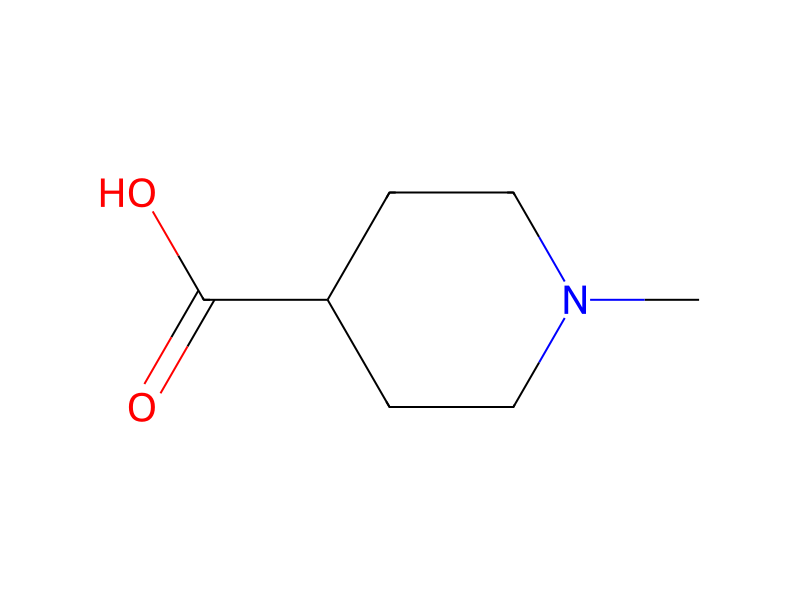
HCID 65578Oxalyl chlorideHCID 8176813-Amino-5-bromopyridineHCID 27369391-Methylpiperidine-4-carboxylic acid

Product 1

HCID 67341499N-(5-bromopyridin-3-yl)-1-methylpiperidine-4-carboxamideYield 47.7%

Reagents, catalysts & solvents 2

HCID 6228DimethylformamideCatalyst
HCID 6344
Dichloromethane
Solvent

Procedure

Oxalyl chloride (8.67 mmol) followed by DMF (2 drops) was added to a solution of 1-methyl piperidine-4-carboxylic acid (XLIII) (5.78 mmol) in DCM and stirred 30 min at room temperature under argon. The volatiles were evaporated under vacuum by avoiding contact with air. Pyridine was added to the residue followed by addition of 3-amino-5-bromopyridine (XL) (5.20 mmol). The solution was further stirred at room temperature for 3 h under argon. The pyridine was evaporated under vacuum. The residue was treated with water, basified by saturated NaHCO3 solution and washed with DCM. The aqueous layer was extracted with n-butanol. The combined organic layer was evaporated. The residue was dissolved in DCM with the addition of few drops of MeOH. The insoluble inorganic solids were filtered off. The filtrate was concentrated under vacuum to get N-(5-bromopyridin-3-yl)-1-methylpiperidine-4-carboxamide (XLIV) as a brown viscous liquid (0.74 g, 43% yield). 1H NMR (DMSO-d6) 1.61-1.69 (m, 2H), 1.77-1.79 (m, 2H), 1.93-1.97 (m, 2H), 2.20 (s, 3H), 2.29-2.35 (m, 1H), 2.84-2.87 (m, 2H), 8.36 (d, J=1.6 Hz, 1H), 8.39 (m, 1H), 8.66 (d, J=1.6 Hz, 1H), 10.33 (s, 1H); ESIMS found C12H16BrN3O m/z 299 (M+H).


Workup

  1. customThe volatiles were evaporated under vacuum
  2. additionPyridine was added to the residue
  3. stirringThe solution was further stirred at room temperature for 3 h under argon
  4. customThe pyridine was evaporated under vacuum
  5. additionThe residue was treated with water
  6. washwashed with DCM
  7. extractionThe aqueous layer was extracted with n-butanol
  8. customThe combined organic layer was evaporated
  9. dissolutionThe residue was dissolved in DCM with the addition of few drops of MeOH
  10. filtrationThe insoluble inorganic solids were filtered off
  11. concentrationThe filtrate was concentrated under vacuum

Sources & evidence

ORD record
ord-c1d1923a571f43579c13017631d76b94
Source dataset
uspto-grants-2015_06
DOI
10.6084/m9.figshare.5104873.v1
Patent number
US09067939B2

Reaction notes

Loading…

On this pageParticipantsProcedureWorkupSources & evidenceReaction notes