Tributylamine → 1-Butanamine, N,N-dibutyl-, hydrochloride (1:1)
HRID 2199366
Reaction equation
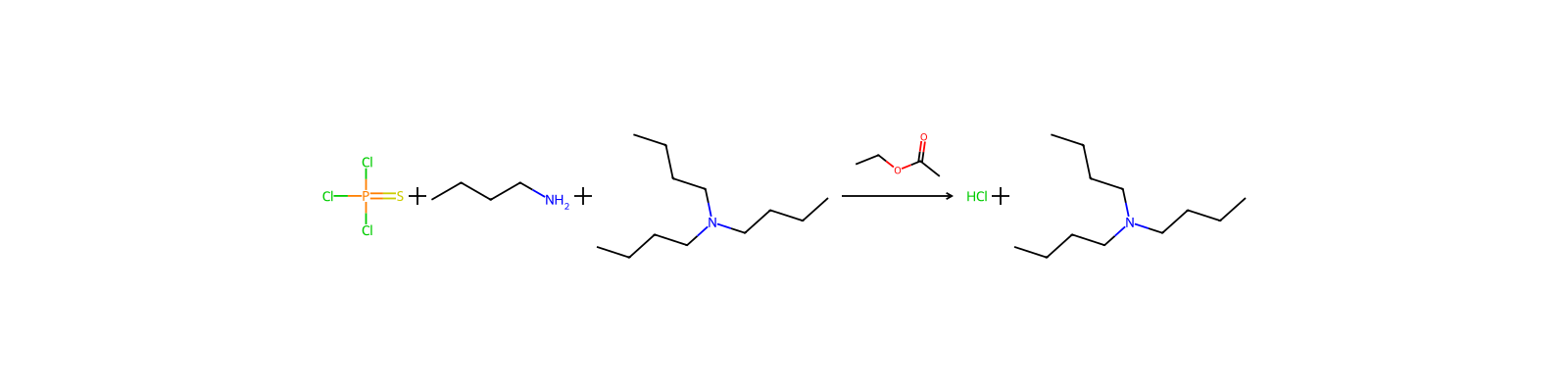
P(Cl)(Cl)([Cl:3])=S.C(N)CCC.[CH2:11]([N:15]([CH2:20][CH2:21][CH2:22][CH3:23])[CH2:16][CH2:17][CH2:18][CH3:19])[CH2:12][CH2:13][CH3:14]>C(OCC)(=O)C>[ClH:3].[CH2:20]([N:15]([CH2:11][CH2:12][CH2:13][CH3:14])[CH2:16][CH2:17][CH2:18][CH3:19])[CH2:21][CH2:22][CH3:23]Participants
5
Reactant 3


Product 1

Reagents, catalysts & solvents 1

Procedure
To this end, thiophosphoryl chloride and a primary alkylamine, for example n-butylamine, are reacted in molar ratios of preferably 0.9 to 1.1 mol of amine per mole of thiophosphoryl chloride in an inert solvent, for example ethyl acetate. The auxiliary base used is a trialkylamine, for example tri-n-butylamine, which is reacted to give the tri-n-butylamine hydrochloride. In a second reaction step, the N-alkylthiophosphoryl dichloride which has been formed in the first reaction is reacted with ammonia at temperatures of between preferably −20° C. and 50° C. to give the desired product N-alkylthiophosphoric triamide. In parallel with, and independently of, the second reaction step, ammonia acts as base 2 and accepts the hydrogen chloride from the trialkylamine hydrochloride with formation of ammonium chloride.