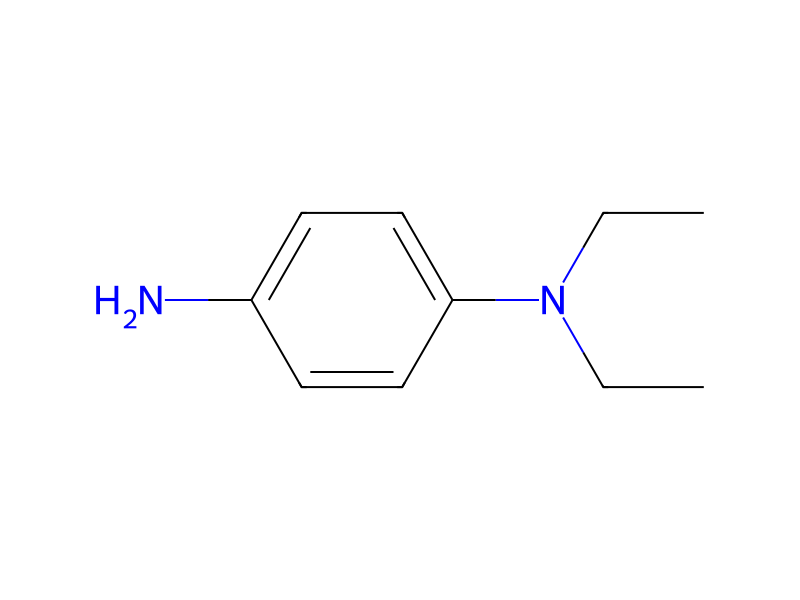
was prepared according to general procedure (A), in which freshly distilled 0.12 μl N,N-diethylbenzene-1,4-diamine (0.74 mmol, 1 equiv), 83 μl formalin (0.1.1 mmol, 1.5 equiv), 0.47 mL 3.14 M hydrochloric acid in ethanol (1.5 mmol, 2 equiv) and 0.16 g (4-methoxyphenyl)(pyridin-2-yl)methanone, (0.74 mmol, 1 equiv) were combined in 1.5 mL acetonitrile and maintained at room temperature for 12 hours. The reaction was concentrated in vacuo and dried under high vacuum at 0.2 Torr. The crude material was then triturated with 1.0 mL acetone and diluted with 0.5 mL diethylether. The resulting solution was decanted and the process was repeated an additional two times. The resulting solid was then dissolved in methanol, transferred to a tared vial, concentrated under a stream of nitrogen, and dried under high vacuum at 0.2 Torr for 48 hours to provide 0.27 g, 2-(4-(diethylamino)phenyl)-1-(4-methoxyphenyl)-2H-imidazo[1,5-a]pyridin-4-ium chloride (0.66 mmol, a 90% yield) as a deliquescent cream colored solid. This material was determined to be the monocationic salt by titration with sodium hydroxide. The material used for fluorescence testing was further purified by recrystallization from acetonitrile and tetrahydrofuran. Crystals used for X-ray diffraction were obtained by layering a concentrated methanolic solution of 2-(4-(diethylamino)phenyl)-1-(4-methoxyphenyl)-2H-imidazo[1,5-a]pyridin-4-ium chloride with pentane.