Reaction equation

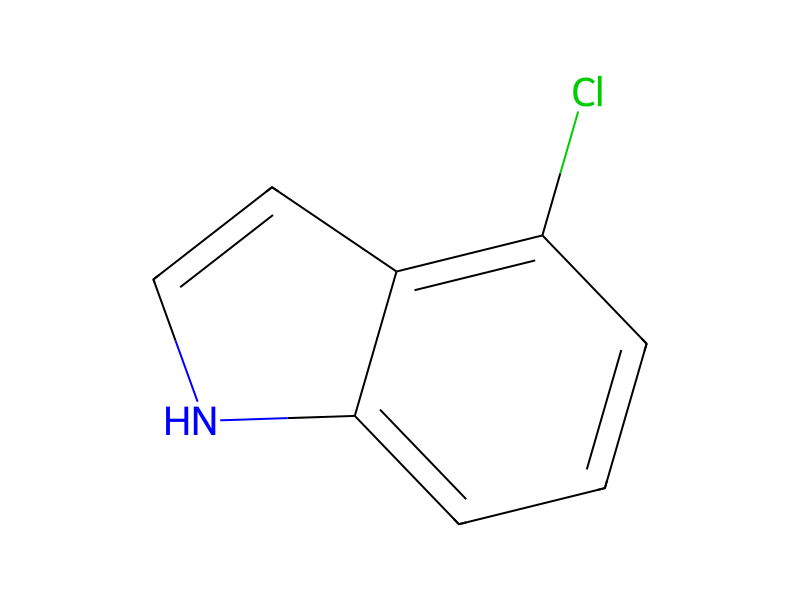
[Cl:1][C:2]1[CH:10]=[CH:9][CH:8]=[C:7]2[C:3]=1[CH:4]=[CH:5][NH:6]2.C([SiH](CC)CC)C>FC(F)(F)C(O)=O>[Cl:1][C:2]1[CH:10]=[CH:9][CH:8]=[C:7]2[C:3]=1[CH2:4][CH2:5][NH:6]2Participants
Reactant 2

Product 1

Reagents, catalysts & solvents 1

Conditions
- Temperature
- 50 °C
Procedure
4-Chloroindole (3.15 g) was dissolved in trifluoroacetic acid (32 ml), thereto was added triethylsilane (8.3 ml) and the mixture was heated at 50° C. with stirring for 30 minutes. The resultant mixture was cooled to room temperature, and trifluoroacetic acid was evaporated under reduced pressure. To the residue was added a saturated aqueous sodium hydrogen carbonate solution, and the mixture was extracted with ethyl acetate twice. The organic layer was dried over magnesium sulfate, and the solvent was evaporated under reduced pressure. The residue was purified by silica gel column chromatography (hexane:ethyl acetate=100:0-80:20) to give 4-chloro-2,3-dihydro-(1H)-indole (2.89 g) as colorless oil. APCI-Mass m/z 154/156 (M+H) (2) The above 4-chloro-2,3-dihydro-(1H)-indole was treated in a manner similar to described in Eur. J. Med. Chem. (2004) 39, 453-458 to give the title compound. APCI-Mass m/z 314/316 (M+H)
Workup
- customtrifluoroacetic acid was evaporated under reduced pressure
- additionTo the residue was added a saturated aqueous sodium hydrogen carbonate solution
- extractionthe mixture was extracted with ethyl acetate twice
- dry with materialThe organic layer was dried over magnesium sulfate
- customthe solvent was evaporated under reduced pressure
- customThe residue was purified by silica gel column chromatography (hexane:ethyl acetate=100:0-80:20)
Sources & evidence
- ORD record
- ord-756f6edbe44347948e370c942c859b07
- Source dataset
- uspto-grants-2012_06
- Patent number
- US08202984B2
Linked notes
Loading…