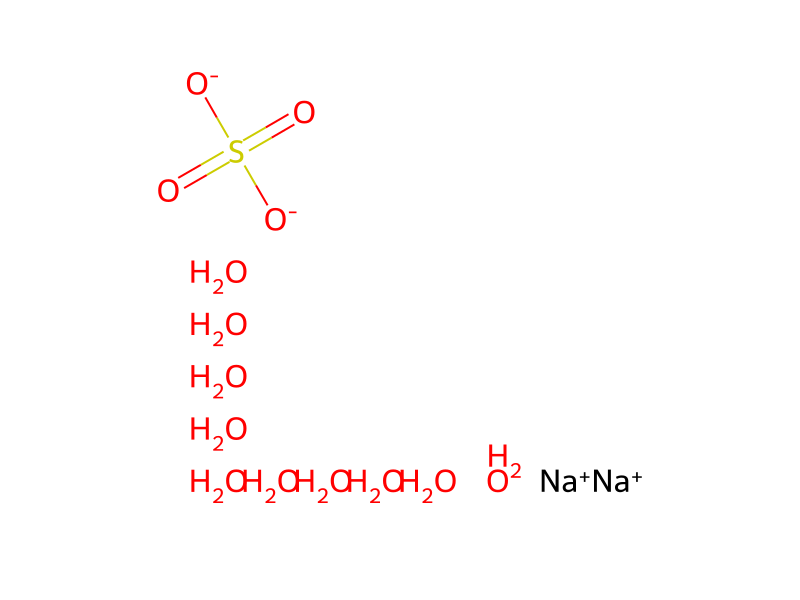
Sodium sulfate decahydrate → HCID 178483465, compound
Reaction equation

[CH3:1][C@H:2]1[CH2:7][CH2:6][C@H:5]([N-:8][CH2:9][CH2:10][CH2:11][CH2:12][N:13]([CH3:15])[CH3:14])[CH2:4][CH2:3]1.[H-].[Al+3].[Li+].[H-].[H-].[H-].O.O.O.O.O.O.O.O.O.O.S([O-])([O-])(=O)=O.[Na+].[Na+]>C1COCC1>[CH3:15][N:13]([CH3:14])[CH2:12][CH2:11][CH2:10][CH2:9][NH:8][C@H:5]1[CH2:6][CH2:7][C@H:2]([CH3:1])[CH2:3][CH2:4]1Participants
Reactant 3


Product 1

Reagents, catalysts & solvents 1

Procedure
13.1 g of N-(trans-4-methylcyclohexyl ) -4-dimethylaminobutylamide (Example 73) was dissolved in 100 ml of THF. Under an argon stream, the solution was added dropwise to a solution of 7.5 g of lithium aluminum hydride suspended in 400 ml of THF under ice-cooling. After the addition, the solution was reacted for 8 hours, while it was refluxed. After reaction, the solution was allowed to cool to room temperature. Then, 22 g of sodium sulfate decahydrate was added to the solution under ice-cooling. The solution was stirred for 1 hour, and the precipitate was filtered out. The solvent was removed in vacuo, yielding an oily substance. This substance was subjected to vacuum distillation, yielding 5.7 g of N-(4-dimethylaminobutyl)-trans-4-methylcyclohexylamine as a colorless oil, which had the following physiochemical properties:
Workup
- temperaturecooling
- additionAfter the addition
- customthe solution was reacted for 8 hours, while it
- temperaturewas refluxed
- customAfter reaction
- temperaturecooling
- filtrationthe precipitate was filtered out
- customThe solvent was removed in vacuo
- customyielding an oily substance
- distillationThis substance was subjected to vacuum distillation
Sources & evidence
- ORD record
- ord-4922bd34b49f4b1fbd9a29e82b835f1e
- Source dataset
- uspto-grants-1994_09
- Patent number
- US05344845
Reaction notes
Loading…