HomeMCPWorkbenchSkills
HomeWorkbenchNotificationsMe
llms.txt · MCP GuidePrivacy Policy · Terms of Service · Supportv1.8.3
  1. Home
  2. /Reaction

N-vinyl-2-pyrrolidone → Nvp hea

HRID 2263445
Print

Reaction equation

HRID 2263445 reaction equation
[CH:1]([N:3]1[CH2:7][CH2:6][CH2:5][C:4]1=[O:8])=[CH2:2].[C:9]([O:13][CH2:14][CH2:15][OH:16])(=[O:12])[CH:10]=[CH2:11].CC(N=NC(C#N)(CCC(O)=O)C)(C#N)CCC(O)=O.N(CCO)(CCO)CCO>O>[CH:1]([N:3]1[CH2:7][CH2:6][CH2:5][C:4]1=[O:8])=[CH2:2].[C:9]([O:13][CH2:14][CH2:15][OH:16])(=[O:12])[CH:10]=[CH2:11]
ParticipantsProcedureWorkupSources & evidenceReaction notes

Participants

6

Reactant 4

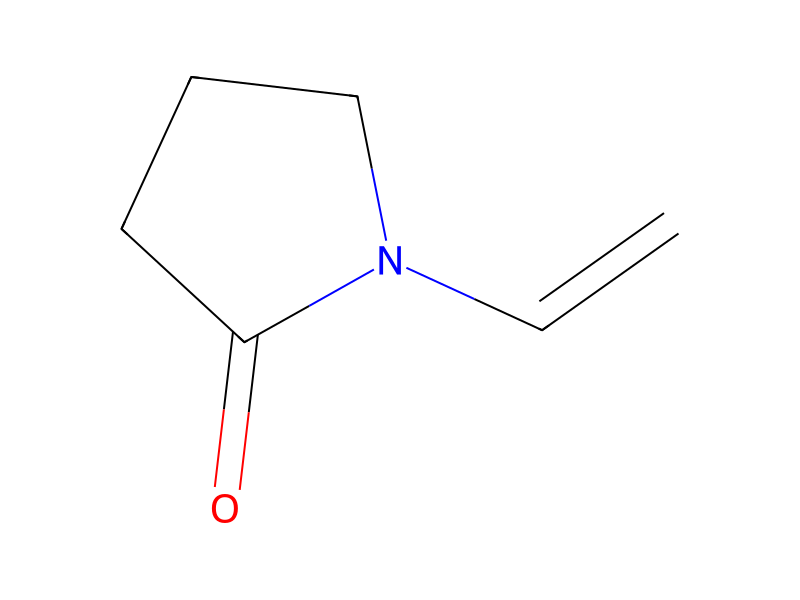
HCID 6917N-vinyl-2-pyrrolidoneHCID 7618TriethanolamineHCID 131652-Hydroxyethyl acrylateHCID 929384,4-Azobis(4-cyanovaleric acid)

Product 1

HCID 68417077Nvp hea

Reagents, catalysts & solvents 1

HCID 962WaterSolvent
3×

Procedure

20 parts of ion-exchange water was charged into a polymerization vessel made of SUS304 equipped with a condenser, a nitrogen introduction line and a thermometer and nitrogen was introduced therein while stirred to render the inside of the polymerization vessel to nitrogen atmosphere. The polymerization vessel was heated in an oil bath until internal temperature thereof became 95° C., and thereafter a monomer solution (AB10) in which 16.8 parts of N-vinylpyrrolidone (NVP), 4.2 parts of 2-hydroxyethyl acrylate (HEA) and 16.4 parts of ion-exchange water were mixed, and an initiator solution (I10) in which 0.75 part of 4,4′-azobis-4-cyanovaleric acid (NC25: manufactured by NIPPOH CHEMICALS CO., LTD.), 0.76 part of triethanolamine (TEA) and 11.1 parts of ion-exchange water were mixed and dissolved were successively-dropped thereinto over 2 hours each. Thereafter, stirring while heated was continued for another 2 hours to obtain a polymer solution (solution of NVP/HEA copolymer, colorless and transparent, solid content of 33.3%). The physical properties of the obtained polymer solution are shown in Table 1.

Workup

  1. customequipped with a condenser
  2. additiona nitrogen introduction line and a thermometer and nitrogen was introduced
  3. temperatureThe polymerization vessel was heated in an oil bath until internal temperature
  4. customthereof became 95° C.
  5. dissolutiondissolved
  6. additionwere successively-dropped
  7. stirringThereafter, stirring
  8. temperaturewhile heated
  9. waitwas continued for another 2 hours

Sources & evidence

ORD record
ord-ec75e4f17c84401caafa3dc7b478aedc
Source dataset
uspto-grants-2010_12
DOI
10.6084/m9.figshare.5104873.v1
Patent number
US07851568B2

Reaction notes

On this pageParticipantsProcedureWorkupSources & evidenceReaction notes
