Reaction equation

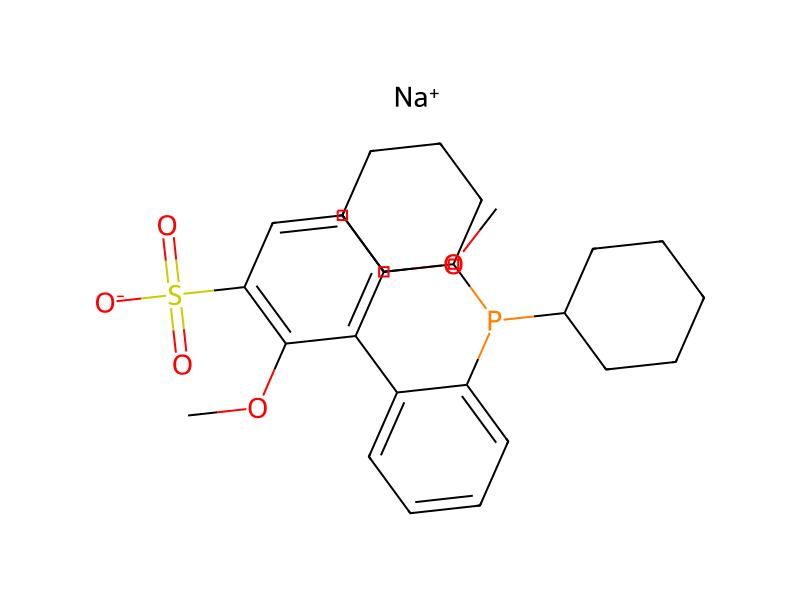
Cl[C:2]1[C:7]([CH3:8])=[CH:6][C:5]([OH:9])=[CH:4][C:3]=1[CH3:10].[CH:11]1[C:24]2[S:23][C:22]3[C:17](=[CH:18][CH:19]=[CH:20][CH:21]=3)[O:16][C:15]=2[C:14](B(O)O)=[CH:13][CH:12]=1.C([O-])([O-])=O.[K+].[K+]>CC([O-])=O.CC([O-])=O.[Pd+2].C1(P(C2CCCCC2)C2C=CC=CC=2C2C(OC)=CC=C(S([O-])(=O)=O)C=2OC)CCCCC1.[Na+].O>[CH3:10][C:3]1[CH:4]=[C:5]([OH:9])[CH:6]=[C:7]([CH3:8])[C:2]=1[C:14]1[C:15]2[O:16][C:17]3[C:22](=[CH:21][CH:20]=[CH:19][CH:18]=3)[S:23][C:24]=2[CH:11]=[CH:12][CH:13]=1Participants
Reactant 3



Product 1

Reagents, catalysts & solvents 3


Procedure
The general procedure described in Example 3 was used with 4-chloro-3,5-dimethyl-phenol (156 mg, 1.00 mmol), 4-phenoxathiineboronic acid (293 mg, 1.20 mmol), Pd(OAc)2 (2.2 mg, 0.010 mmol, 1 mol %), sodium 2-dicyclohexylphosphino-2′,6′-dimethoxybiphenyl-3′-sulfonate (10.0 mg, 0.020 mmol, 2 mol %), K2CO3 (414 mg, 3.00 mmol), water (3.0 mL), 12 h, 100° C. The product was isolated as a colorless oil (277 mg, 85%), which became a white solid upon standing. Mp=116° C. 1H NMR (400 MHz, CDCl3) δ: 7.20 (m, 2H), 7.01-7.16 (m, 3H), 6.96 (d, 1H, J=7.6 Hz), 6.73 (m, 3H), 5.64 (s, 1H), 2.04 (s, 6H). 13C NMR (125 MHz, CDCl3) δ: 154.6, 152.6, 149.9, 138.3, 130.2, 129.9, 129.5, 127.8, 126.8, 126.1, 124.7, 124.6, 121.2, 121.1, 118.2, 114.2, 20.9. IR (neat, cm−1): 3367, 1593, 1471, 1419, 1311, 1265, 1223, 1154, 1026, 752. Anal. Calcd for C20H16O2S: C, 74.97; H, 5.03. Found: C, 74.88; H, 4.99.
Sources & evidence
- ORD record
- ord-d0837b1c391c4d8295cab629d5897900
- Source dataset
- uspto-grants-2009_07
- Patent number
- US07560596B2
Linked notes
Loading…