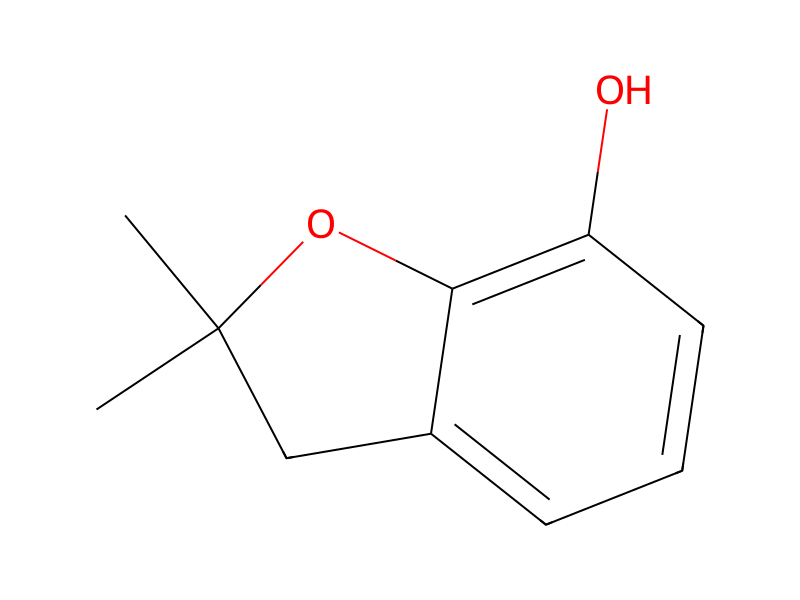
C(=O)([O-])[O-].[K+].[K+].[Cl:7][C:8]1[CH:9]=[C:10]([N+:15]([O-:17])=[O:16])[CH:11]=[CH:12][C:13]=1Cl.[CH3:18][C:19]1([CH3:29])[CH2:23][C:22]2[CH:24]=[CH:25][CH:26]=[C:27]([OH:28])[C:21]=2[O:20]1>CN(C=O)C>[Cl:7][C:8]1[CH:9]=[C:10]([N+:15]([O-:17])=[O:16])[CH:11]=[CH:12][C:13]=1[O:28][C:27]1[C:21]2[O:20][C:19]([CH3:29])([CH3:18])[CH2:23][C:22]=2[CH:24]=[CH:25][CH:26]=1To a mixture containing 32.63 g (0.236 mole) of anhydrous potassium carbonate and 30.41 g (0.158 mole) of 3,4-dichloro-1-nitrobenzene in 250 ml of dry DMF at room temperature and under an atmosphere of nitrogen was added 30.88 g (0.188 mole) of 2,3-dihydro-2,2-dimethyl-7-hydroxybenzofuran. The reaction mixture was then placed in an oil bath and heated to 110° C. for 20 hours The reaction mixture was cooled to room temperature. The DMF was removed under vacuum. The residue was dissolved in 1.5 L of 1:1 ethylacetate:ether and 300 ml of water. The layers were separated. The organic layer was washed twice with 5% NaOH, twice with H2O and once with a saturated aqueous NaCl solution. After drying over anhydrous Na2SO4, removal of the solvents afforded 48.42 g of a light tan solid. This was recrystallized from hexane:ethyl acetate to afford 44.19 g of white crystals mp 132°-133° C. NMR (CDCl3): δ1.42 (s, 6H), 3.05 (s, 2H), 6.5-7.2 (m, 4H), 7.95 (doft, J=9, 2 Hz, 1H), 8.28 (d, J=2 Hz, 1H).