HomeMCPWorkbenchSkills
HomeWorkbenchNotificationsMe
llms.txt · MCP GuidePrivacy Policy · Terms of Service · Supportv1.8.3
  1. Home
  2. /Reaction

Cesium carbonate → 4-(8-Nitroquinolin-3-yl)-1,4-diazabicyclo[3.2.2]nonane

HRID 2308179
Print

Reaction equation

HRID 2308179 reaction equation
Br[C:2]1[CH:3]=[N:4][C:5]2[C:10]([CH:11]=1)=[CH:9][CH:8]=[CH:7][C:6]=2[N+:12]([O-:14])=[O:13].[N:15]12[CH2:23][CH2:22][CH:19]([CH2:20][CH2:21]1)[NH:18][CH2:17][CH2:16]2.C(=O)([O-])[O-].[Cs+].[Cs+]>O1CCCC1.C1(C)C=CC=CC=1.C([O-])(=O)C.C([O-])(=O)C.[Pd+2].C1(P(C2C=CC=CC=2)C2C=CC3C(=CC=CC=3)C=2C2C3C(=CC=CC=3)C=CC=2P(C2C=CC=CC=2)C2C=CC=CC=2)C=CC=CC=1>[N+:12]([C:6]1[CH:7]=[CH:8][CH:9]=[C:10]2[C:5]=1[N:4]=[CH:3][C:2]([N:18]1[CH:19]3[CH2:22][CH2:23][N:15]([CH2:21][CH2:20]3)[CH2:16][CH2:17]1)=[CH:11]2)([O-:14])=[O:13]
ParticipantsConditionsProcedureWorkupSources & evidenceReaction notes

Participants

8

Reactant 3

HCID 10796Cesium carbonateHCID 79286Quinoline, 3-bromo-8-nitro-HCID 3984071,4-Diazabicyclo(3.2.2)nonane

Product 1

HCID 98147644-(8-Nitroquinolin-3-yl)-1,4-diazabicyclo[3.2.2]nonaneYield 71.9%

Reagents, catalysts & solvents 4

HCID 167845palladium(II) acetateCatalyst
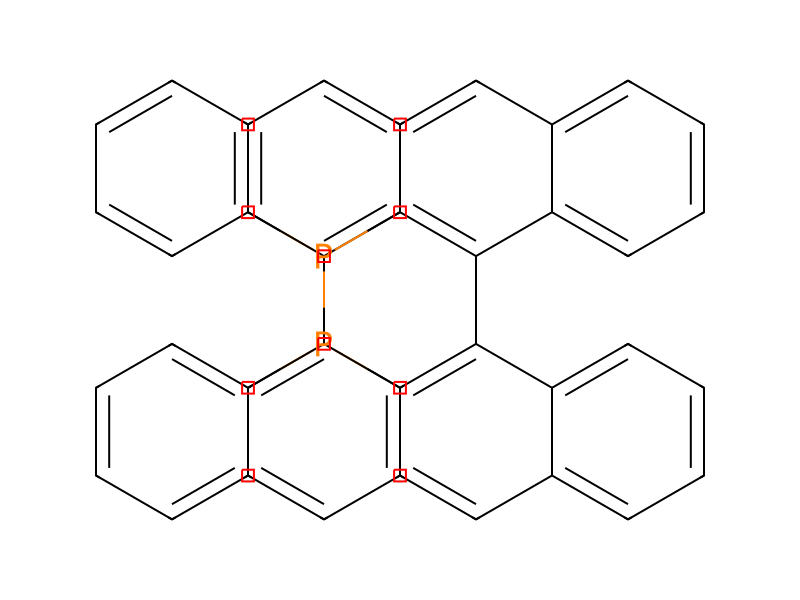
HCID 634876
Binap, (A+-)-
Catalyst
HCID 1140TolueneSolvent
HCID 8028TetrahydrofuranSolvent

Conditions

Temperature
85 °C

Procedure

1.54 g (6.1 mmol) of 3-bromo-8-nitro_quinoline, 0.7 g (5.5 mmol) of 1,4-diazabicyclo—[3.2.2]nonane, 0.05 g (0.22 mmol) of palladium diacetate, 2.5 g (7.7 mmol) of cesium carbonate and 0.137 g (0.22 mmol) of 2,2′-bis(diphenylphosphino)-1,1′-binaphthyl, in 30 ml of tetrahydrofuran and 10 ml of toluene, are introduced consecutively into a 100 ml three-necked round-bottomed flask and the reaction mixture is heated at 80-90° C. for 24 h. The inorganic products are separated by filtration and the solvent is evaporated under reduced pressure. The residue is purified by chromatography on a silica gel column, with the elution being carried out using a 95/5/0.5, and then a 90/10/1, mixture of dichloromethane, methanol and ammonia. 1.18 g of solid are obtained, with this solid then being recrystallized in methanol.

Workup

  1. customThe inorganic products are separated by filtration
  2. customthe solvent is evaporated under reduced pressure
  3. customThe residue is purified by chromatography on a silica gel column, with the elution
  4. additiona 90/10/1, mixture of dichloromethane, methanol and ammonia

Sources & evidence

ORD record
ord-9affa0c960874479a572c044febdb7e1
Source dataset
uspto-grants-2004_12
DOI
10.6084/m9.figshare.5104873.v1
Patent number
US06835730B2

Reaction notes

On this pageParticipantsConditionsProcedureWorkupSources & evidenceReaction notes