Triethylamine → 3-(2-Acetamidoethylthio)-2-oxoglutaric acid
Reaction equation

Br[CH:2]([CH2:8][C:9]([OH:11])=[O:10])[C:3](=[O:7])[C:4]([OH:6])=[O:5].[C:12]([NH:15][CH2:16][CH2:17][SH:18])(=[O:14])[CH3:13].C(N(CC)CC)C>ClCCl>[C:12]([NH:15][CH2:16][CH2:17][S:18][CH:2]([CH2:8][C:9]([OH:11])=[O:10])[C:3](=[O:7])[C:4]([OH:6])=[O:5])(=[O:14])[CH3:13]Participants
5
Reactant 3

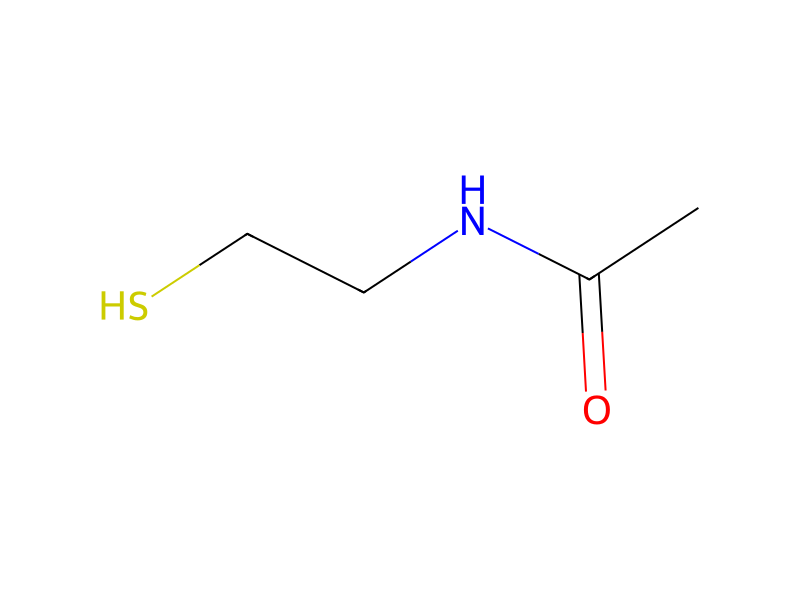

Product 1

Reagents, catalysts & solvents 1

Procedure
In 20 ml of dichloromethane was suspended 1.0 g of 3-bromo-2-oxoglutaric acid. To the suspension was added, while stirring under ice-cooling, 0.5 g of 2-acetamidoethanethiol, followed by addition of 1.83 ml of triethylamine. The reaction solution was stirred at room temperature for one hour, then the solvent was evaporated off. To the residue were added ethyl acetate and water. The aqueous layer was taken, which was adjusted to pH 1~2 with 1N-HCl, followed by extraction with ethyl acetate. The extract solution was washed with water and dried (MgSO4), followed by evaporating off the solvent to give 0.67 g of 3-(2-acetamidoethylthio)-2-oxoglutaric acid as a pale yellow oily product. To this product were added, while stirring under ice-cooling, 0.32 ml of dicyclohexylamine and 0.34 g of 4-nitrobenzyl bromide. The reaction solution was stirred for 15 hours at room temperature, followed by dilution with ethyl acetate. The crystals which separated out were filtered off, and the filtrate was washed with water and dried (MgSO4), followed by evaporating off the solvent. The residue was subjected to a silica gel column chromatography, followed by elution with ethyl acetate then with ethyl acetate--acetic acid (100:3) to give 0.4 g of the subject Compound (70) as a pale yellow oily product.