HomeMCPWorkbenchSkills
HomeWorkbenchNotificationsMe
llms.txt · MCP GuidePrivacy Policy · Terms of Service · Supportv1.8.0
  1. Home
  2. /Reaction

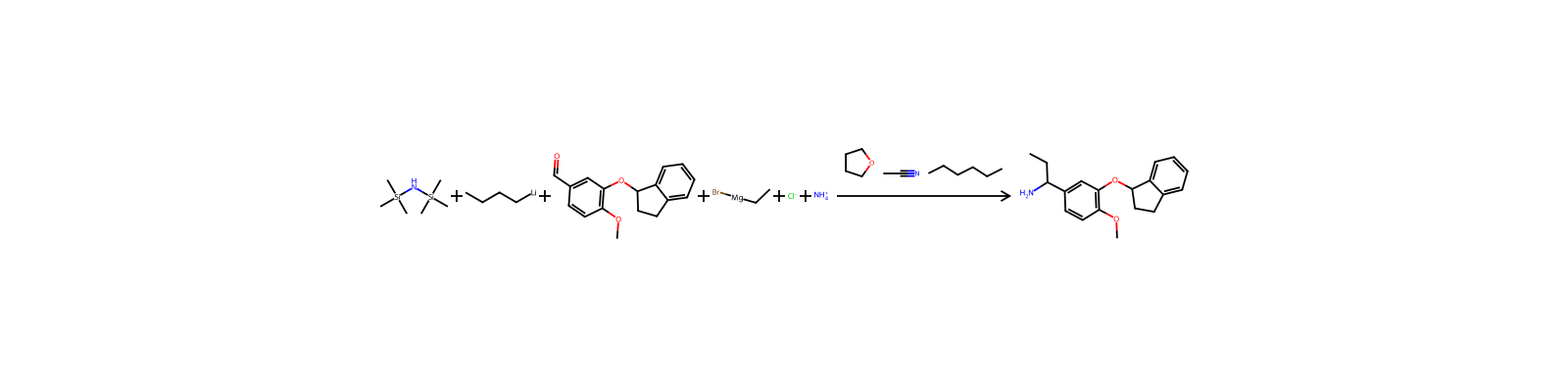
Hexamethyldisilazane → 1-(3-Indanyloxy-4-methoxyphenyl)propylamine

HRID 2350
Notes
Print preview

Reaction equation

HRID 2350 reaction equation
C[Si](C)(C)N[Si](C)(C)C.C([Li])C[CH2:12][CH3:13].[CH:15]1([O:24][C:25]2[CH:26]=[C:27]([CH:30]=[CH:31][C:32]=2[O:33][CH3:34])[CH:28]=O)[C:23]2[C:18](=[CH:19][CH:20]=[CH:21][CH:22]=2)[CH2:17][CH2:16]1.C([Mg]Br)C.[Cl-].[NH4+:40]>O1CCCC1.CC#N.CCCCCC>[CH:15]1([O:24][C:25]2[CH:26]=[C:27]([CH:28]([NH2:40])[CH2:12][CH3:13])[CH:30]=[CH:31][C:32]=2[O:33][CH3:34])[C:23]2[C:18](=[CH:19][CH:20]=[CH:21][CH:22]=2)[CH2:17][CH2:16]1
ParticipantsProcedureWorkupSources & evidenceReaction notes

Participants

9

Reactant 5

HCID 13838HexamethyldisilazaneHCID 25517Ammonium ChlorideHCID 572579703-Indanyloxy-4-methoxybenzaldehydeHCID 178418339ButyllithiumHCID 178418443HCID 178418443, compound

Product 1

HCID 570150481-(3-Indanyloxy-4-methoxyphenyl)propylamineYield 9%

Reagents, catalysts & solvents 3

HCID 6342AcetonitrileSolventHCID 8028TetrahydrofuranSolvent2×HCID 8058HexaneSolvent

Procedure

To an ice bath cooled stirred solution of 1,1,1,3,3,3-hexamethyldisilazane (2.7 mL, 13 mmol) in tetrahydrofuran (5 mL) under nitrogen, was added a hexane solution of butyl lithium (2.5M, 4.8 mL, 12 mmol) via syringe. The ice bath was removed and the solution was stirred for 25 minutes at room temperature. This solution then was added dropwise to an ice bath cooled solution of 3-indanyloxy-4-methoxybenzaldehyde (2.68 g, 10.0 mmol) in tetrahydrofuran (4 mL) and the mixture was stirred for one hour. An ethereal solution of ethylmagnesium bromide (3M, 6.7 mL, 20 mmol) then was added dropwise via syringe. The reaction mixture was heated at reflux and was monitored by HPLC (Waters Nova-Pak/EC 18 column, 3.9×150 mm, 4 micron, 1 mL/min, 240 nm, 40/60, CH3CN/0.1% H3PO4 (aq)). After 48 hours the reaction had reached completion and was allowed to cool to room temperature. The reaction mixture then was slowly poured into a saturated solution of ammonium chloride (80 mL). The resulting mixture was extracted with methylene chloride (3×15 mL) and the combined extracts were dried over magnesium sulfate and concentrated to afford the product which was further purified by flash column chromatography (silica gel, 250/10/1, methylene chloride/methanol/ammonium hydroxide) to afford 0.27 g (9%) of product as an orange solid.
Workup

  1. temperatureTo an ice bath cooled
  2. customThe ice bath was removed
  3. additionThis solution then was added dropwise to an ice bath
  4. stirringthe mixture was stirred for one hour
  5. temperatureThe reaction mixture was heated
  6. temperatureat reflux
  7. waitAfter 48 hours the reaction had reached
  8. temperatureto cool to room temperature
  9. extractionThe resulting mixture was extracted with methylene chloride (3×15 mL)
  10. dry with materialthe combined extracts were dried over magnesium sulfate
  11. concentrationconcentrated
  12. customto afford the product which
  13. customwas further purified by flash column chromatography (silica gel, 250/10/1, methylene chloride/methanol/ammonium hydroxide)

Sources & evidence

ORD record
ord-a172f4e4b1614e5bac954c6d01d97ff6
Source dataset
uspto-grants-1998_03
DOI
10.6084/m9.figshare.5104873.v1
Patent number
US05728844

Reaction notes

Loading…

On this pageParticipantsProcedureWorkupSources & evidenceReaction notes




