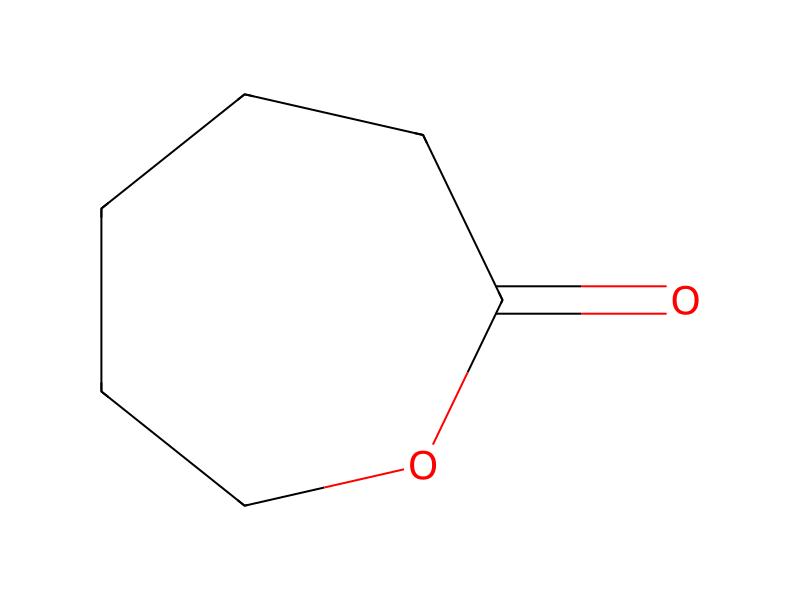
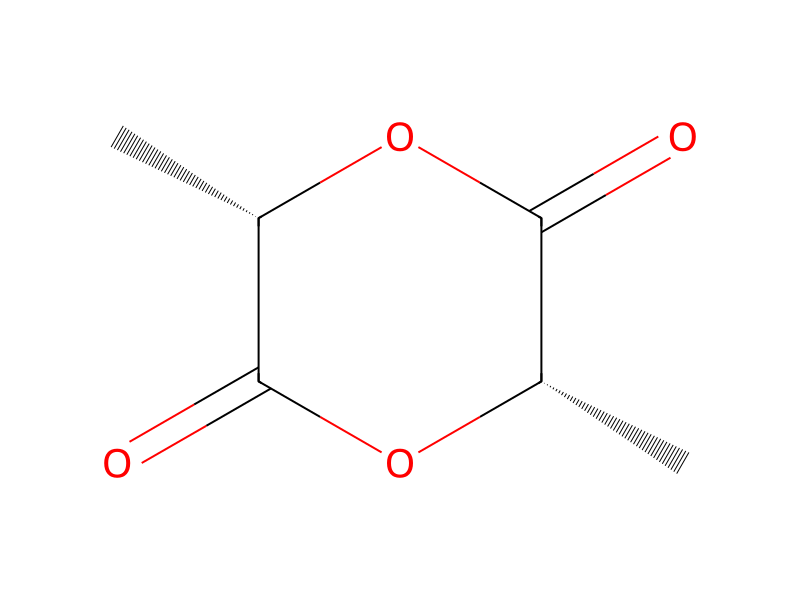
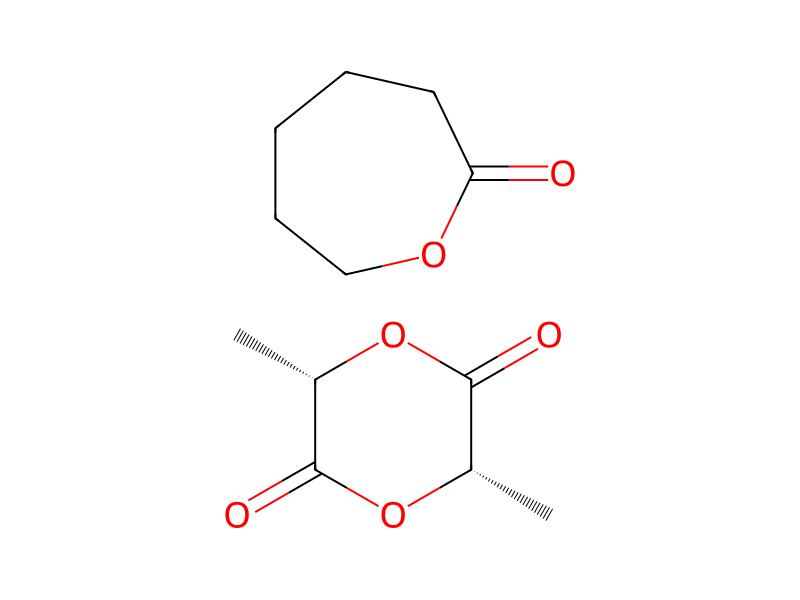
2-ethylhexanoic acid tin(II) salt → L-lactide epsilon-caprolactone
Reaction equation

[CH3:1][C@@H:2]1[O:9][C:7](=[O:8])[C@H:6]([CH3:10])[O:5][C:3]1=[O:4].[C:11]1(=[O:18])[O:17][CH2:16][CH2:15][CH2:14][CH2:13][CH2:12]1.CCCCC(C([O-])=O)CC.CCCCC(C([O-])=O)CC.[Sn+2]>>[CH3:1][C@@H:2]1[O:9][C:7](=[O:8])[C@H:6]([CH3:10])[O:5][C:3]1=[O:4].[C:11]1(=[O:18])[O:17][CH2:16][CH2:15][CH2:14][CH2:13][CH2:12]1Participants
4

Procedure
The procedure of Example II is repeated except that 20 grams of L-(-)-lactide, 30 grams of epsilon caprolactone and 0.0105 grams of pure stannous octoate are placed in a glass flask, blanketed with nitrogen, and heated for 45 hours at 140° to 142° C. The copolymer is tough and elastic and has good tensile strength and elongation properties. The copolymer has a GPC molecular weight of Mw =323,000 and Mn =180,000. DSC of the copolymer reveals a moderate amount of crystallinity with a melting point endo-therm of 42° C. and a glass transition temperature of -16° C. Physical properties of the polymer are shown in Table 1.