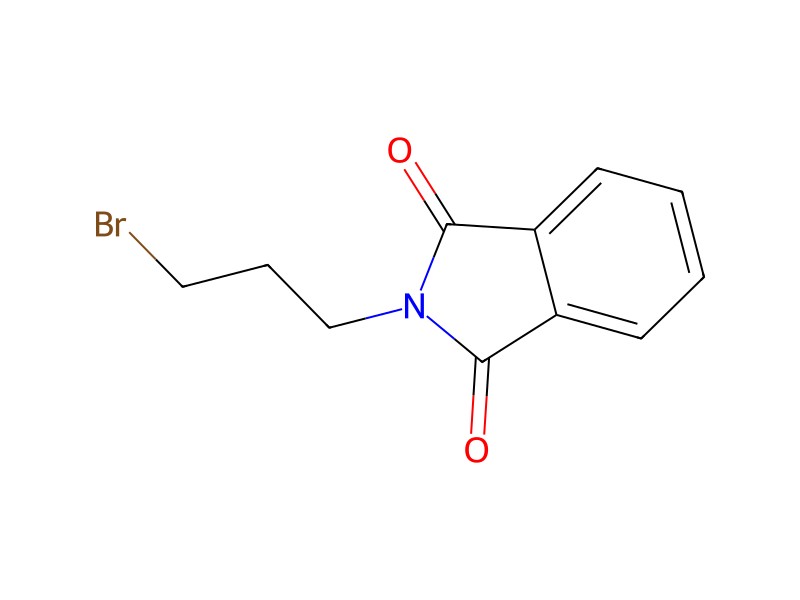
C(=O)([O-])[O-].[K+].[K+].Br[CH2:8][CH2:9][CH2:10][N:11]1[C:15](=[O:16])[C:14]2=[CH:17][CH:18]=[CH:19][CH:20]=[C:13]2[C:12]1=[O:21].CN(C)C=O.[F:27][C:28]1[CH:33]=[CH:32][C:31]([OH:34])=[C:30]([N+:35]([O-:37])=[O:36])[CH:29]=1>O>[F:27][C:28]1[CH:33]=[CH:32][C:31]([O:34][CH2:8][CH2:9][CH2:10][N:11]2[C:15](=[O:16])[C:14]3[C:13](=[CH:20][CH:19]=[CH:18][CH:17]=3)[C:12]2=[O:21])=[C:30]([N+:35]([O-:37])=[O:36])[CH:29]=1Potassium carbonate (10.8 g, 78.1 mmol) and N-(3-bromopropyl)phthalimide (12.1 g, 45.1 mmol) were added to a N,N-dimethylformamide (DMF) solution (80 ml) of 4-fluoro-2-nitrophenol (6.0 g, 38.2 mmol), and the mixture was stirred at 60° C. for 4 hours. After the reaction mixture was cooled to room temperature, water (200 ml) was added, and the reaction mixture was then cooled with ice. The precipitated insoluble matter was collected by filtration. After being washed with water (50 ml×3), the substance remaining in the filter was air-dried, giving 13.2 g of powdery pale yellow 2-[3-(4-fluoro-2-nitrophenoxy)propyl]isoindole-1,3-dione (yield: 100%).
Loading…