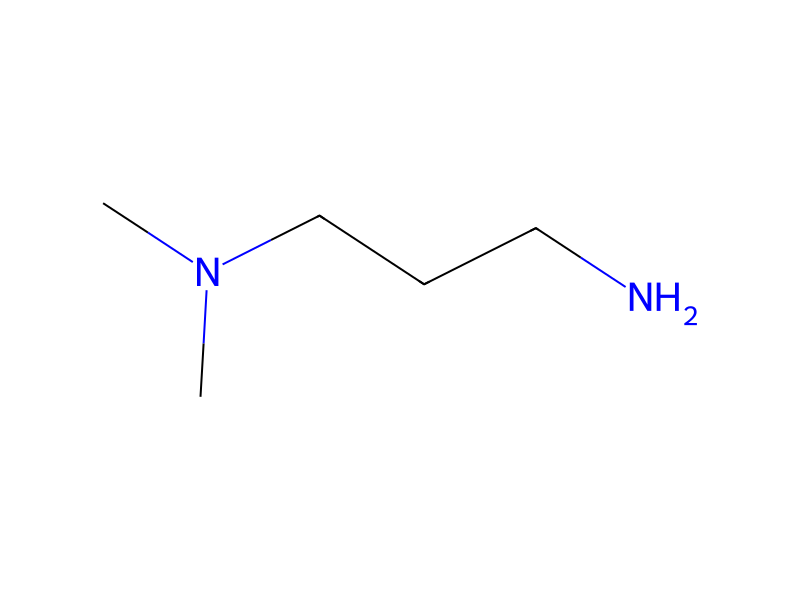
C(N1C=CN=C1)(N1C=CN=C1)=O.[C:13]([O:17][C:18]([NH:20][CH2:21][CH2:22][CH2:23][CH2:24][CH2:25][CH2:26][CH2:27][CH2:28][CH2:29][CH2:30][C:31]([OH:33])=O)=[O:19])([CH3:16])([CH3:15])[CH3:14].[CH3:34][N:35]([CH3:40])[CH2:36][CH2:37][CH2:38][NH2:39]>O1CCCC1.ClCCl>[C:13]([O:17][C:18](=[O:19])[NH:20][CH2:21][CH2:22][CH2:23][CH2:24][CH2:25][CH2:26][CH2:27][CH2:28][CH2:29][CH2:30][C:31](=[O:33])[NH:39][CH2:38][CH2:37][CH2:36][N:35]([CH3:40])[CH3:34])([CH3:14])([CH3:15])[CH3:16]1,1′-Carbonyldiimidazole (118 mg, 0.73 mmol) was added to a solution of acid 3 (200 mg, 0.66 mmol) in a mixture of tetrahydrofuran (5 mL) and dichloromethane (1 mL). The resulting solution was stirred at ambient temperature for 4 h. 3-(Dimethylamino)propylamine (0.10 mL, 0.79 mmol) was then added and stirring continued for 14 hours at room temperature. The solvent was then removed under vacuum. The resulting residue was dissolved in dichloromethane (10 mL) and washed sequentially with aqueous sodium bicarbonate (1×10 mL), and then water (1×10 mL). The organic layer was dried over anhydrous sodium sulfate and concentrated to give compound 4 (154 mg, 61%) as a clear oil: 1H NMR (500 MHz, CDCl3) δ 1.27 (m, 12H), 1.57 (br, 14H), 1.56-1.65 (m, 2H), 1.67-1.74 (m, 2H), 2.16 (t, 2H, J=7.5 Hz), 2.32 (s, 6H), 2.51 (t, 2H, J=6.7 Hz) 3.29-3.33 (m, 2H), 4.51 (br, 1H); m/z (ESI) 386 [C21H43N3O3+H]+.