HomeMCPWorkbenchSkills
HomeWorkbenchNotificationsMe
llms.txt · MCP GuidePrivacy Policy · Terms of Service · Supportv1.8.3
  1. Home
  2. /Reaction

Hydrochloric Acid → 1-{3-Fluoro-4-[(phenylmethyl)oxy]phenyl}-4-hydroxy-1H-indole-6-carbonitrile

HRID 2421238
Print

Reaction equation

HRID 2421238 reaction equation
Br[C:2]1[CH:10]=[C:9]([C:11]#[N:12])[CH:8]=[C:7]2[C:3]=1[CH:4]=[CH:5][N:6]2[C:13]1[CH:18]=[CH:17][C:16]([O:19][CH2:20][C:21]2[CH:26]=[CH:25][CH:24]=[CH:23][CH:22]=2)=[C:15]([F:27])[CH:14]=1.[OH-:28].[K+].Cl>O1CCOCC1.O.C(OCC)(=O)C.C1C=CC(/C=C/C(/C=C/C2C=CC=CC=2)=O)=CC=1.C1C=CC(/C=C/C(/C=C/C2C=CC=CC=2)=O)=CC=1.C1C=CC(/C=C/C(/C=C/C2C=CC=CC=2)=O)=CC=1.[Pd].[Pd].C(P(C(C)(C)C)C1C=CC=CC=1C1C(C(C)C)=CC(C(C)C)=CC=1C(C)C)(C)(C)C>[F:27][C:15]1[CH:14]=[C:13]([N:6]2[C:7]3[C:3](=[C:2]([OH:28])[CH:10]=[C:9]([C:11]#[N:12])[CH:8]=3)[CH:4]=[CH:5]2)[CH:18]=[CH:17][C:16]=1[O:19][CH2:20][C:21]1[CH:26]=[CH:25][CH:24]=[CH:23][CH:22]=1
ParticipantsConditionsProcedureWorkupSources & evidenceReaction notes

Participants

9

Reactant 3

HCID 313Hydrochloric AcidHCID 14797Potassium HydroxideHCID 671360974-bromo-1-{3-fluoro-4-[(phenylmethyl)oxy]phenyl}-1H-indole-6-carbonitrile

Product 1

HCID 668767931-{3-Fluoro-4-[(phenylmethyl)oxy]phenyl}-4-hydroxy-1H-indole-6-carbonitrileYield 94.9%

Reagents, catalysts & solvents 5

HCID 9811564
Bis(dibenzylideneacetone)palladium
Catalyst
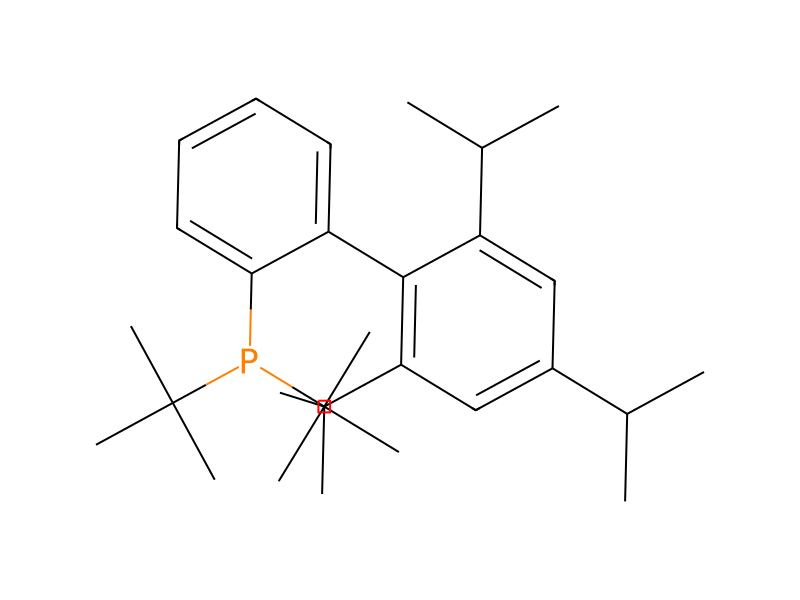
HCID 11618717Di-tert-butyl(2',4',6'-tris(propan-2-yl)-(1,1'-biphenyl)-2-yl)phosphaneCatalyst
HCID 962WaterSolvent2×
HCID 8857Ethyl AcetateSolvent
HCID 312751,4-DioxaneSolvent

Conditions

Temperature
85 °C

Procedure

To a solution of 4-bromo-1-{3-fluoro-4-[(phenylmethyl)oxy]phenyl}-1H-indole-6-carbonitrile (D13) (400 mg, 0.95 mmol) in dioxane (6 mL) and water (6 mL) was added potassium hydroxide (216 mg, 3.9 mmol). The reaction mixture was degassed with argon and then treated with 2-di-tert-butylphosphino-2′,4′,6′-trisisopropylbiphenyl (22 mg, 0.05 mmol) and tris(dibenzylideneacetone)dipalladium (0) (19 mg, 0.02 mmol). After heating at 85° C. for 1 hour, the mixture was allowed to cool to room temperature and then diluted with ethyl acetate and water. The pH was adjusted to 7 by the addition of 1M hydrochloric acid. The organic phase was dried over magnesium sulphate, filtered and concentrated in vacuo. The product was purified by silica gel chromatography eluting with 2-60% ethyl acetate in hexane to yield the title compound (D14), (323 mg).

Workup

  1. customThe reaction mixture was degassed with argon
  2. temperatureto cool to room temperature
  3. dry with materialThe organic phase was dried over magnesium sulphate
  4. filtrationfiltered
  5. concentrationconcentrated in vacuo
  6. customThe product was purified by silica gel chromatography
  7. washeluting with 2-60% ethyl acetate in hexane

Sources & evidence

ORD record
ord-38ff31d153a44211aea2e45e5e7a93d0
Source dataset
uspto-grants-2011_06
DOI
10.6084/m9.figshare.5104873.v1
Patent number
US07956083B2

Reaction notes

On this pageParticipantsConditionsProcedureWorkupSources & evidenceReaction notes