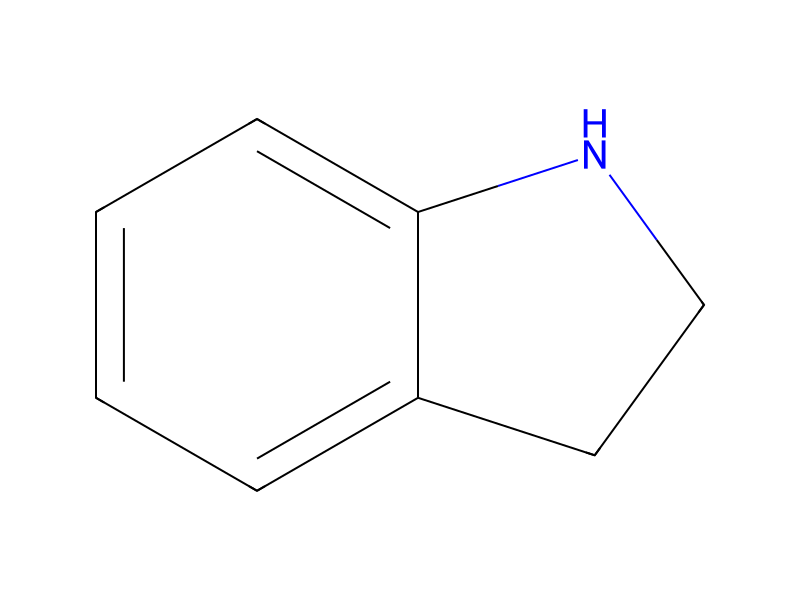
[F:1][C:2]1[CH:3]=[C:4]([N:16]2[C:24]3[C:19](=[C:20]([O:25]CC4C=CC=CC=4)[CH:21]=[CH:22][CH:23]=3)[CH:18]=[CH:17]2)[CH:5]=[CH:6][C:7]=1[O:8]CC1C=CC=CC=1.C(Cl)(Cl)Cl.CCCCCC.N1C2C(=CC=CC=2)CC1>C(O)C.C(OCC)(=O)C.CO.[Pd]>[F:1][C:2]1[CH:3]=[C:4]([N:16]2[C:24]3[CH:23]=[CH:22][CH:21]=[C:20]([OH:25])[C:19]=3[CH:18]=[CH:17]2)[CH:5]=[CH:6][C:7]=1[OH:8]A suspension of 1-{3-fluoro-4-[(phenylmethyl)oxy]phenyl}-4-[(phenylmethyl)oxy]-1H-indole (D1) (2.32 g, 5.48 mmol) in ethanol (100 mL) and ethyl acetate (100 mL) was hydrogenated in the presence of 10% Pd on charcoal (500 mg) at atmospheric pressure and room temperature overnight. The mixture was filtered and concentrated and then purified by chromatography on silica gel (elution with 0-50% ethyl acetate in hexane) to give a pink gum, which was solidified by the addition of chloroform (˜0.5 mL) and hexane. The product was collected by filtration and washed with hexane to give an off white powder. This product was dissolved in methanol and passed through an SCX cartridge (to trap a trace of indoline formed in the reaction) and the cartridge was eluted with methanol. The product containing fractions were concentrated and then triturated with hexane and dried to give the title compound (E1) as an off-white solid (905 mg).