Reaction equation
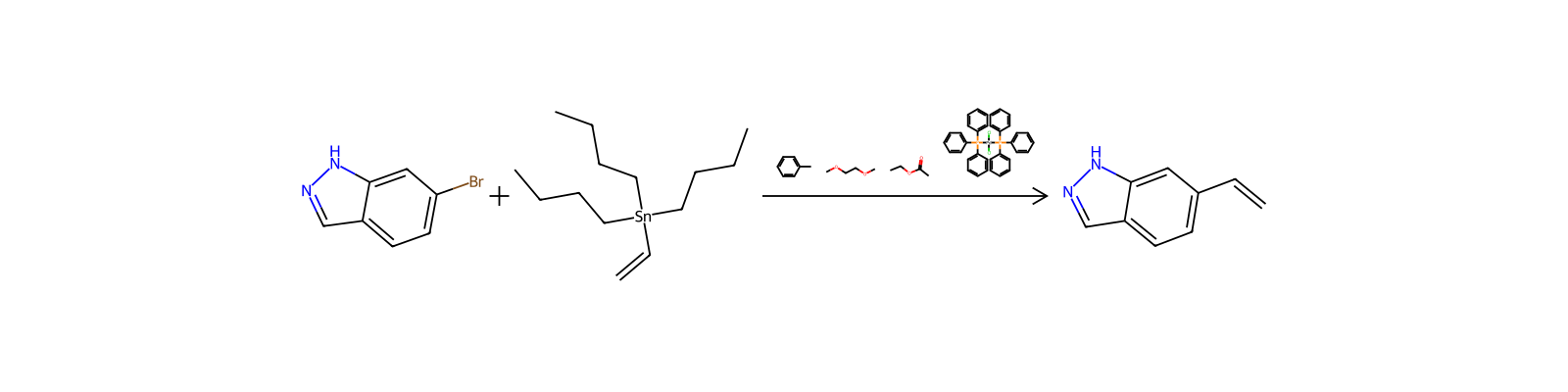
Br[C:2]1[CH:10]=[C:9]2[C:5]([CH:6]=[N:7][NH:8]2)=[CH:4][CH:3]=1.[CH2:11]([Sn](CCCC)(CCCC)C=C)[CH2:12]CC>C1(C)C=CC=CC=1.COCCOC.C(OCC)(=O)C.Cl[Pd](Cl)([P](C1C=CC=CC=1)(C1C=CC=CC=1)C1C=CC=CC=1)[P](C1C=CC=CC=1)(C1C=CC=CC=1)C1C=CC=CC=1>[CH:11]([C:2]1[CH:10]=[C:9]2[C:5]([CH:6]=[N:7][NH:8]2)=[CH:4][CH:3]=1)=[CH2:12]Participants






Procedure
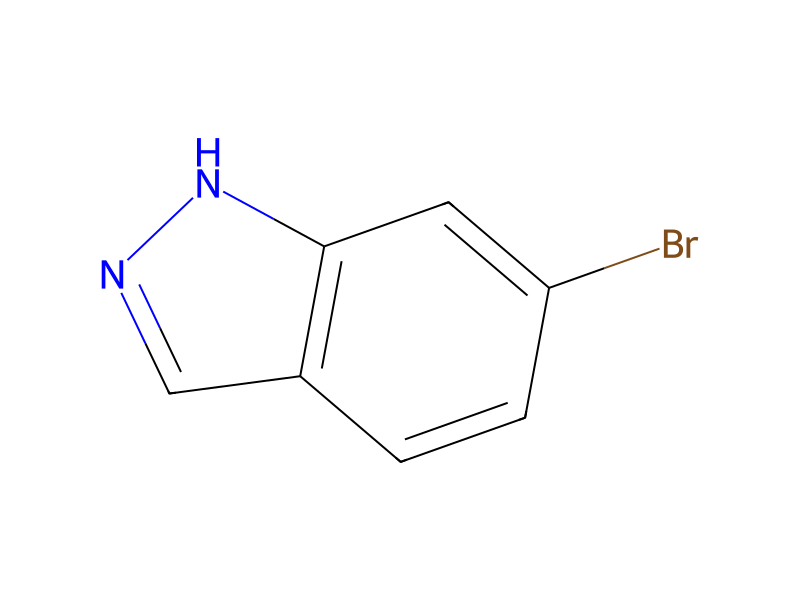
To a suspension of 6-bromo-1H-indazole (600 mg, 3.05 mmol) in toluene (18 ml) and 1,2-dimethoxyethane (6 ml) were added tributyl(vinyl)tin (1.33 ml, 4.57 mmol) and PdCl2(PPh3)2 (214 mg, 0.31 mmol). The reaction was purged with argon then heated at reflux for 3 h. Additional tributyl(vinyl)tin (0.66 ml, 2.28 mmol) and PdCl2(PPh3)2 (107 mg, 0.15 mmol) were added and heating was continued for 1 h. The same reaction was performed on an additional batch of 6-bromo-1H-indazole (200 mg, 1.02 mmol) and the two crude batches were combined. The reactions were diluted with ethyl acetate, washed with water and brine, dried over MgSO4 and concentrated. The residue was purified by silica gel chromatography with 5% to 50% EtOAc/heptane to isolate 350 mg (60%) of 6-vinyl-1H-indazole as a yellow solid. 1H NMR (CDCl3, 300 MHz): δ (ppm) 8.07 (s, 1H), 7.72 (d, J=8.3 Hz, 1H), 7.48 (s, 1H), 7.35 (d, J=8.3 Hz, 1H), 6.85 (dd, J=17.4, 11.0 Hz, 1H), 5.86 (d, J=17.4 Hz, 1H), 5.35 (d, J=11.0 Hz, 1H).
Workup
- customThe reaction was purged with argon
- temperaturethen heated
- temperatureat reflux for 3 h
- temperatureheating
- customThe same reaction
- washwashed with water and brine
- dry with materialdried over MgSO4
- concentrationconcentrated
- customThe residue was purified by silica gel chromatography with 5% to 50% EtOAc/heptane
Sources & evidence
- ORD record
- ord-8738c4ec8dc447b684710ede3a89b834
- Source dataset
- uspto-grants-2014_02
- Patent number
- US08658646B2
Linked notes
Loading…