Reaction equation

[N+](C1C=CC(C(CC(C)(C)C)(C)C)=CC=1N=NC1C=CC=CC=1O)([O-])=O.[C:27]1(=[O:40])[C:39]2[C:31]([C:32]3[C:37]([CH:38]=2)=[CH:36][CH:35]=[CH:34][CH:33]=3)=[CH:30][CH:29]=[CH:28]1.[OH-].[Na+].O=C[C@@H]([C@H]([C@@H]([C@@H](CO)O)O)O)O.Cl>O.CO>[C:27]1([OH:40])[C:39]2[CH2:38][C:37]3[C:32](=[CH:33][CH:34]=[CH:35][CH:36]=3)[C:31]=2[CH:30]=[CH:29][CH:28]=1Participants
Reactant 5



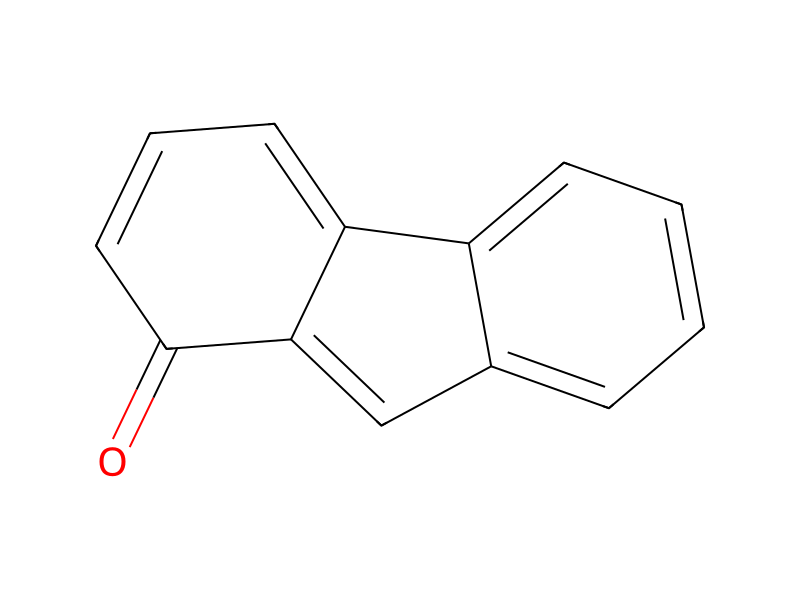

Product 1
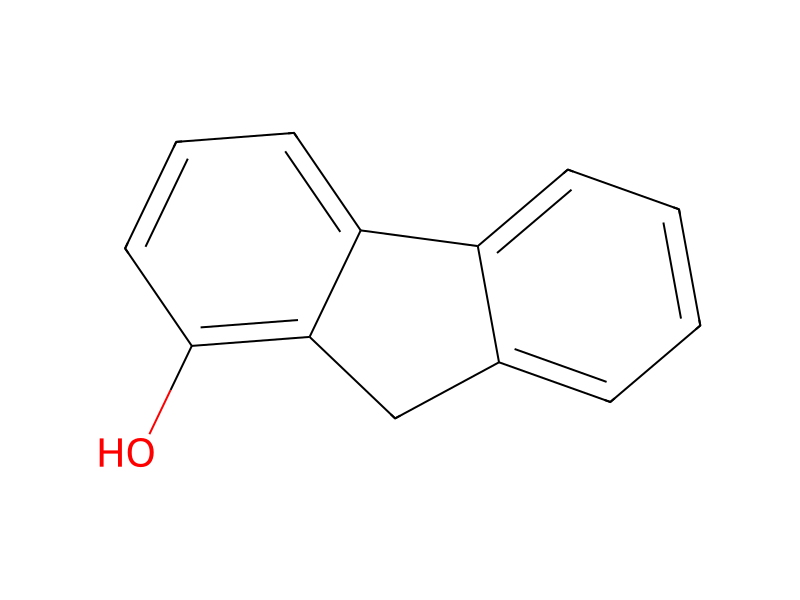
Reagents, catalysts & solvents 2


Conditions
- Temperature
- 25 °C
Procedure
35.5g (0.1 mole) of 2-nitro-2'-hydroxy-5-t-octylazobenzene are added to the mixture of 60 ml of methanol, 2.3 g of fluorenone and 64 g of 50% aqueous solution of sodium hydroxide. The mixture is stirred at 70°-75° C. and to the mixture is slowly added 55.4 g (0.3 mol) of glucose in 55 ml of water over 2 hours. The reaction mixture is heated for an additional three hours, then 160 ml of methanol is added at 55°-60° C. and 14.2 g of 35% hydrochloric acid slowly added and stirred at 40°-50° C. for 20 minutes. During this time crystals should appear. Then more hydrochloric acid is added to attain pH 4-5. The reaction is cooled to 25° C. to yield 26.5 g (82%). Compared to Example 1, above, more than three times the amount of fluorenone is needed, more than double the reaction time is required, and a lower yield is obtained than when fluorenol is used.
Workup
- customover 2 hours
- temperatureThe reaction mixture is heated for an additional three hours
- stirringstirred at 40°-50° C. for 20 minutes
- customto yield 26.5 g (82%)
- customa lower yield
Sources & evidence
- ORD record
- ord-595104ecf37c4d60b2c2382eb6768fd0
- Source dataset
- uspto-grants-1993_11
- Patent number
- US05262541
Linked notes
Loading…