HomeMCPWorkbenchSkills
HomeWorkbenchNotificationsMe
llms.txt · MCP GuidePrivacy Policy · Terms of Service · Supportv1.8.0
  1. Home
  2. /Reaction

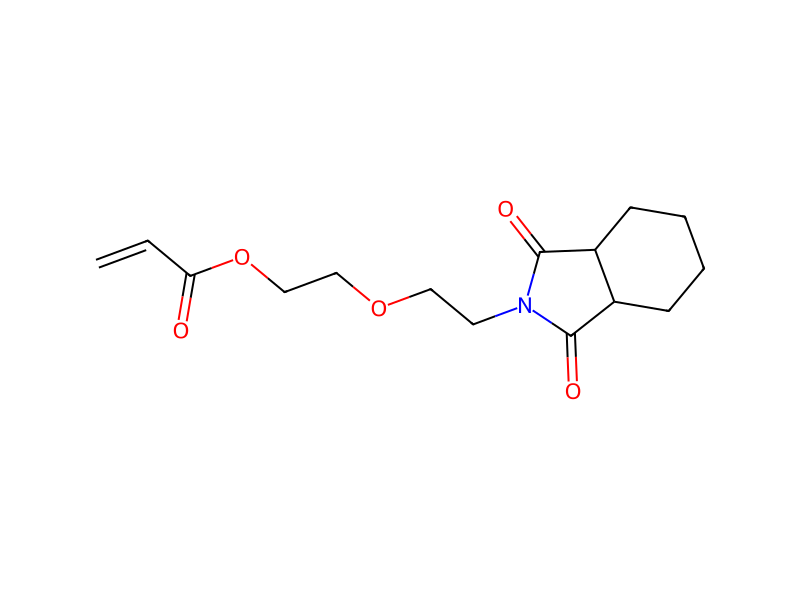
Triethylamine → N-(Acryloyloxyethoxyethyl)hexahydrophthalimide

HRID 259662
Notes
Print preview

Reaction equation

HRID 259662 reaction equation
[OH:1][CH2:2][CH2:3][O:4][CH2:5][CH2:6][N:7]1[C:11](=[O:12])[CH:10]2[CH2:13][CH2:14][CH2:15][CH2:16][CH:9]2[C:8]1=[O:17].C(N(CC)CC)C.[C:25](Cl)(=[O:28])[CH:26]=[CH2:27]>C1C2NC3C(=CC=CC=3)SC=2C=CC=1.CC(C)=O>[C:25]([O:1][CH2:2][CH2:3][O:4][CH2:5][CH2:6][N:7]1[C:11](=[O:12])[CH:10]2[CH2:13][CH2:14][CH2:15][CH2:16][CH:9]2[C:8]1=[O:17])(=[O:28])[CH:26]=[CH2:27]
ParticipantsProcedureWorkupSources & evidenceReaction notes

Participants

6

Reactant 3

HCID 8471TriethylamineHCID 13140Acryloyl chlorideHCID 55023972N-(2-hydroxyethoxyethyl)hexahydrophthalimide

Product 1

HCID 67622109N-(Acryloyloxyethoxyethyl)hexahydrophthalimideYield 59.5%

Reagents, catalysts & solvents 2

HCID 7108PhenothiazineCatalyst
HCID 180
Acetone
Solvent

Procedure

A one liter, three necked flask was equipped with overhead stirrer, nitrogen atmosphere and an addition funnel. The flask was charged with 100 g of N-(2-hydroxyethoxyethyl)hexahydrophthalimide (0.41 mol.), 42 g of triethylamine (0.41 mol.), 1 g of phenothiazine and 400 ml of acetone. Next, 38 g of acryloyl chloride (0.41 mol.) was added slowly to the flask via the addition funnel over 45 minutes. The reaction was stirred for an additional 12 hours. The triethylamine hydrochloride salt was removed by filtration and the remaining mother liquor was evaporated with a rotoevaporator. The resulting red-orange liquid was dissolved in chloroform and extracted with HCl(10%), NaCl(aq.), NH4OH(10%), NaCl(aq.) and dried over MgSO4. The chloroform was removed with a rotoevaporator to yield 72 g (59%) of an orange-red liquid. The product was confirmed by IR and 13C NMR.

Workup

  1. customA one liter, three necked flask was equipped with overhead stirrer
  2. customThe triethylamine hydrochloride salt was removed by filtration
  3. customthe remaining mother liquor was evaporated with a rotoevaporator
  4. dissolutionThe resulting red-orange liquid was dissolved in chloroform
  5. extractionextracted with HCl(10%), NaCl(aq.), NH4OH(10%), NaCl(aq.)
  6. dry with materialdried over MgSO4
  7. customThe chloroform was removed with a rotoevaporator

Sources & evidence

ORD record
ord-e4ba0c99ac55476c974c9b8056f79017
Source dataset
uspto-grants-1996_06
DOI
10.6084/m9.figshare.5104873.v1
Patent number
US05523152

Reaction notes

Loading…

On this pageParticipantsProcedureWorkupSources & evidenceReaction notes