Reaction equation
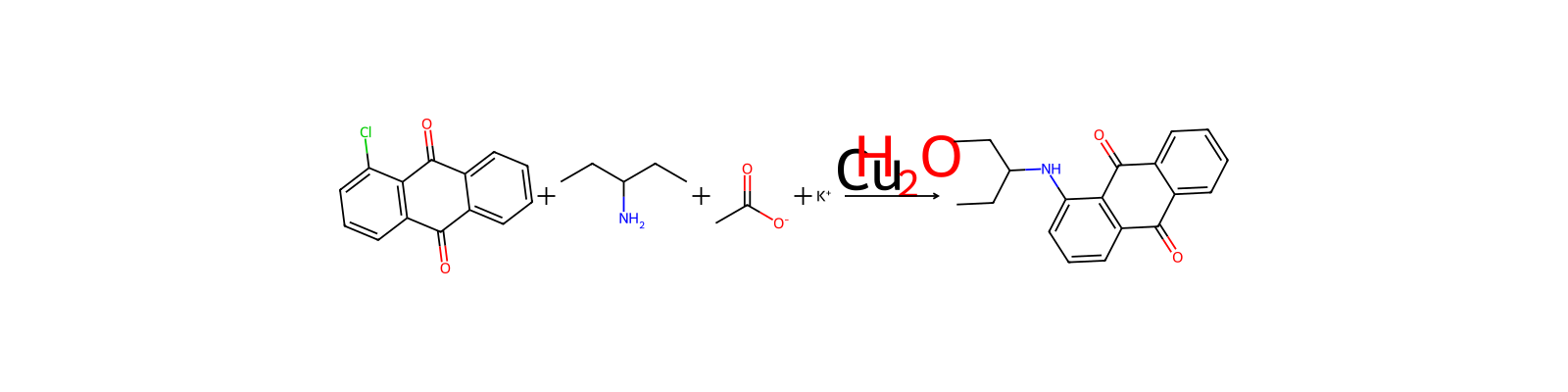
Cl[C:2]1[C:15]2[C:14](=[O:16])[C:13]3[C:8](=[CH:9][CH:10]=[CH:11][CH:12]=3)[C:7](=[O:17])[C:6]=2[CH:5]=[CH:4][CH:3]=1.[CH2:18]([CH:20]([NH2:23])[CH2:21][CH3:22])[CH3:19].C([O-])(=O)C.[K+]>[Cu].O>[CH2:18]([CH:20]([NH:23][C:2]1[C:15]2[C:14](=[O:16])[C:13]3[C:8](=[CH:9][CH:10]=[CH:11][CH:12]=3)[C:7](=[O:17])[C:6]=2[CH:5]=[CH:4][CH:3]=1)[CH2:21][CH3:22])[CH3:19]Participants
6
Reactant 3



Product 1

Reagents, catalysts & solvents 2


Conditions
- Temperature
- 180 °C
Procedure
A Parr stainless steel high pressure reactor was charged with 1-chloroanthraquinone (24.3 g), 1-ethylpropylamine (17.5 g), potassium acetate (14.0 g), activated copper metal (0.7 g), and water (0.05 g). The reaction vessel was sealed and heated to a temperature of 180° C. in an oil bath for 12 hours. The oil bath was removed and the vessel was allowed to return to ambient conditions. The solid was extracted with methylene chloride and the insoluble materials removed by filtration. The solvent was removed and the solid recrystallized from hot methanol. The material was chromatographed on a silica gel column using toluene as the eluent.
Workup
- customThe reaction vessel was sealed
- customThe oil bath was removed
- extractionThe solid was extracted with methylene chloride
- customthe insoluble materials removed by filtration
- customThe solvent was removed
- customthe solid recrystallized from hot methanol
- customThe material was chromatographed on a silica gel column
Sources & evidence
- ORD record
- ord-900e32d5cc3c440e9f39f7144b589599
- Source dataset
- uspto-grants-1996_06
- Patent number
- US05530067
Linked notes
Loading…