HomeMCPWorkbenchSkills
HomeWorkbenchNotificationsMe
llms.txt · MCP GuidePrivacy Policy · Terms of Service · Supportv1.8.0
  1. Home
  2. /Compound

1-Chloroanthraquinone

HCID 6709
New noteNew reactionRequest quotes
Print preview

Completing data — refresh the page later to see the latest

Basic informationNames & identifiersPropertiesSafety & regulationChemistry & industryRelated reactionsCompound notes
Substructure searchFind similar structures

Basic information

CAS
26264-07-3
Standard SMILES
O=C1c2ccccc2C(=O)c2c(Cl)cccc21
InChIKey
BOCJQSFSGAZAPQ-UHFFFAOYSA-N
Molecular formula
C14H7ClO2
Average molar mass
242.65 g/mol
Monoisotopic mass
242.01345714

Names & identifiers

Preferred name
1-Chloroanthraquinone
IUPAC
1-chloroanthracene-9,10-dione
English name
1-Chloro anthraquinone
Molecular formula
C14H7ClO2
Molecular weight
242.66

Names & synonyms

1-CHLOROANTHRAQUINONE82-44-0Anthraquinone, 1-chloro-1-Chloro-9,10-anthraquinone9,10-Anthracenedione, 1-chloro-1-Chloranthrachinon1-Chloranthrachinon [Czech]alpha-Chloroanthraquinone1-chloro-9,10-Anthracenedionealpha-Monochloroanthraquinone.alpha.-MonochloroanthraquinoneDTXSID7052571
Show more names
1-CHLOROANTHRACENE-9,10-DIONE1-CHLORO AQTIMTEC-BB SBB0008251-Chloro anthraquino-Chloroanthraquinone1-Chloroantraquinone1-chloro-anthraquinon
HSDB 2565EINECS 201-421-4NSC 30428BRN 191275296S5SQV15VAI3-38116NSC-5138NSC-30428

Database identifiers

CAS
26264-07-3、82-44-0
PubChem CID
6709
DTXSID
DTXSID7052571
ChEMBL
CHEMBL3560876
UNII
96S5SQV15V
EC Number
201-421-4
Nikkaji
J55.388C

Properties

Computed structural propertiesFilling in

XLogP
4
Topological polar surface area
34.1 Ų
Hydrogen bond donors
0
Hydrogen bond acceptors
2
Rotatable bonds
0
Heavy atoms
17
Formal charge
0
Complexity
352

Experimental & physicochemical properties

Chemical ClassesOther Classes -> Aromatic Ketones
SpringerMaterials Properties13C nuclear magnetic resonance spectrum
Color/FormYELLOW NEEDLES FROM TOLUENE OR ALCOHOL
Solubility · 3 items

INSOL IN WATER; SLIGHTLY SOL IN HOT ALCOHOL; SOL IN NITROBENZENE & HOT AMYL ALCOHOL

Sol in ethanol, benzene, acetic acid

Soluble in oxygenated solvents

Boiling PointSublimes
DecompositionWhen heated to decomp it emits very toxic fumes of /hydrogen chloride and nitrogen oxides/.
Melting Point162 °C
Vapor Pressure0.00000087 [mmHg]
Physical DescriptionYellow solid; [HSDB] Yellow powder; [MSDSonline]

Safety & regulation

Safety information is for reference only and does not replace the supplier’s Safety Data Sheet (SDS), applicable regulations, or professional assessment.

GHS classification

GHS Classification · 5 items

This chemical does not meet GHS hazard criteria for 8.5% (4 of 47) of reports.

Warning

H315 (89.4%): Causes skin irritation [Warning Skin corrosion/irritation]

P261, P264, P264+P265, P271, P280, P302+P352, P304+P340, P305+P351+P338, P319, P321, P332+P317, P337+P317, P362+P364, P403+P233, P405, and P501 (click each P-code to see the statement)

Aggregated GHS information provided per 47 reports by companies from 4 notifications to the ECHA C&L Inventory. Each notification may be associated with multiple companies.

Hazard information

Regulatory Information · 2 items

Chemical: 9,10-Anthracenedione, 1-chloro-

9,10-Anthracenedione, 1-chloro-: Does not have an individual approval but may be used as a component in a product covered by a group standard. It is not approved for use as a chemical in its own right.

Hazards Summary · 1 item

A skin and eye irritant; [HSDB] Causes abnormal liver function test results after subcutaneous injection of experimental animals; [RTECS] An irritant; Effects in high-dose animal studies include impaired liver function tests; [MSDSonline] See Anthraquinone.

Hazard Classes and CategoriesSkin Irrit. 2 (89.4%)
Skin, Eye, and Respiratory IrritationsA skin, eye irritant.

Safety & protection

Disposal Methods · 1 item

SRP: At the time of review, criteria for land treatment or burial (sanitary landfill) disposal practices are subject to significant revision. Prior to implementing land disposal of waste residue (including waste sludge), consult with environmental regulatory agencies for guidance on acceptable disposal practices.

Chemistry & industry

Pharmacology

Metabolism/MetabolitesQuinones (ie, 6,12-dione) have been shown to undergo oxidation-reduction cycles involving quinone, hydroquinone, and molecular oxygen, resulting in the formation of oxygen radicals and semiquinone radicals. /Quinones/

Uses & manufacturing

Uses · 3 items

Used as a chemical intermediate for dyes; [HSDB]

CHEM INTERMEDIATE FOR THE DYES DISPERSE RED 9, VAT BROWN 1, VAT ORANGE 11

Derivatives of 1-chloroanthraquinone include Disperse Red 9, Disperse Red 22, Vat Brown 1, Vat Brown 44, Vat Yellow 28.

U.S. Imports · 2 items

(1972) 2.91X10+7 G (PRINCPL CUSTMS DISTS)

(1975) 7.09X10+6 G

U.S. Production(1972) 5.17X10+7 G
Methods of Manufacturing · 3 items

REACTION OF 1-HYDROXYANTHRAQUINONE WITH PHOSPHORUS PENTACHLORIDE IN NITROBENZENE

1-Chloroanthraquinone is prepared from anthraquinone-1-sulfonic acid or from 1-nitro-anthraquinone. Purification by high temperature distillation.

1-Chloroanthraquinone is prepared from anthraquinone-1-sulfonic acid, sodium salt and sodium chlorate (sulfonate displacement).

General Manufacturing Information9,10-Anthracenedione, 1-chloro-: ACTIVE

Applications

Uses1-Chloroanthraquinone is an intermediate for manufacturing vat dyes such as CI Vat Brown 1.

Uses1-Chloroanthraquinone is used to characterize anthraquinone intercalators as carrier molecules for second-generation platinum anticancer drugs.

Upstream & downstream products

Related reactions

27 records
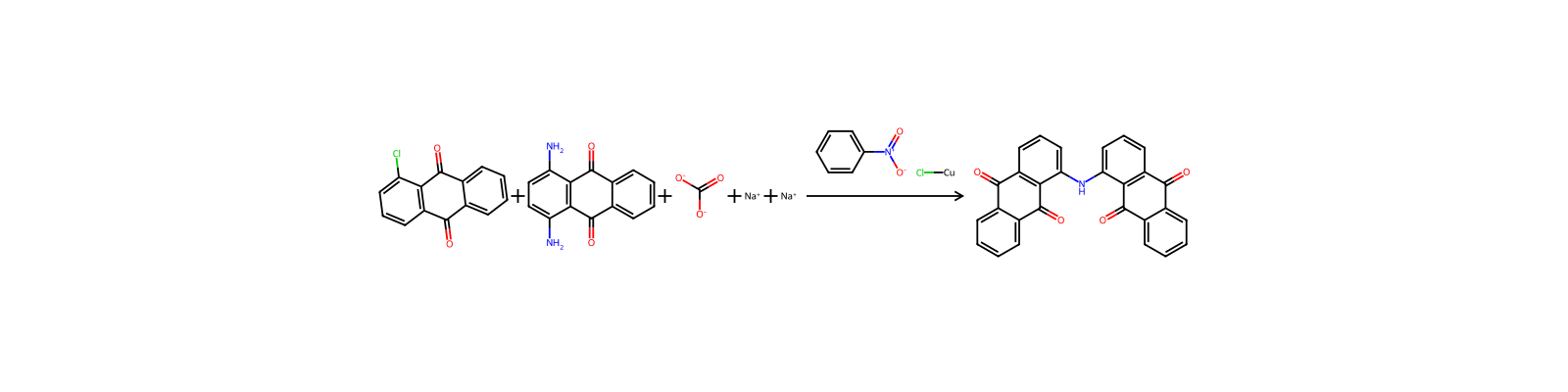
New reaction record
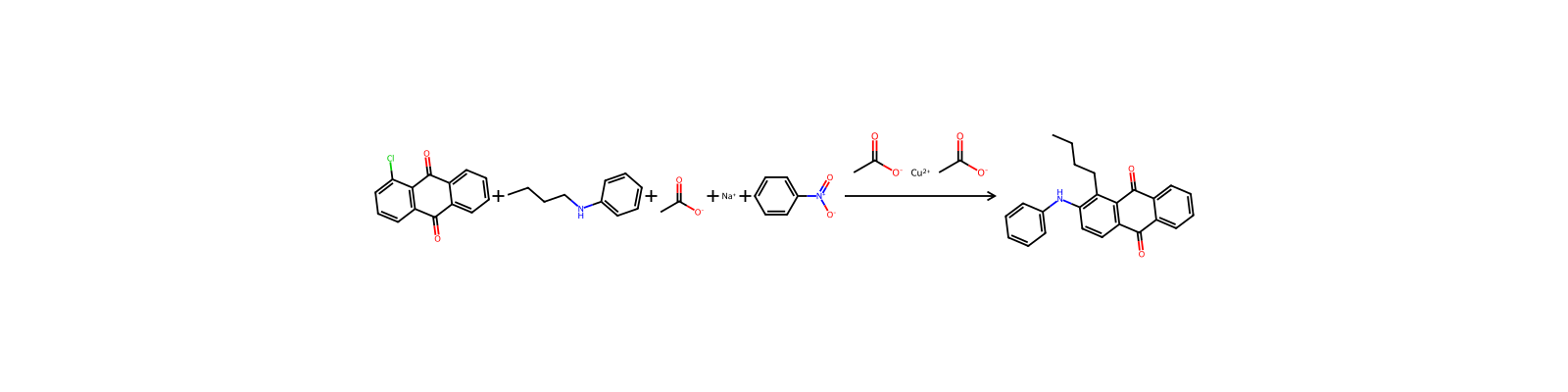
HRID 226253 reaction equation
HRID 226253As reactantuspto-grants-2009_07
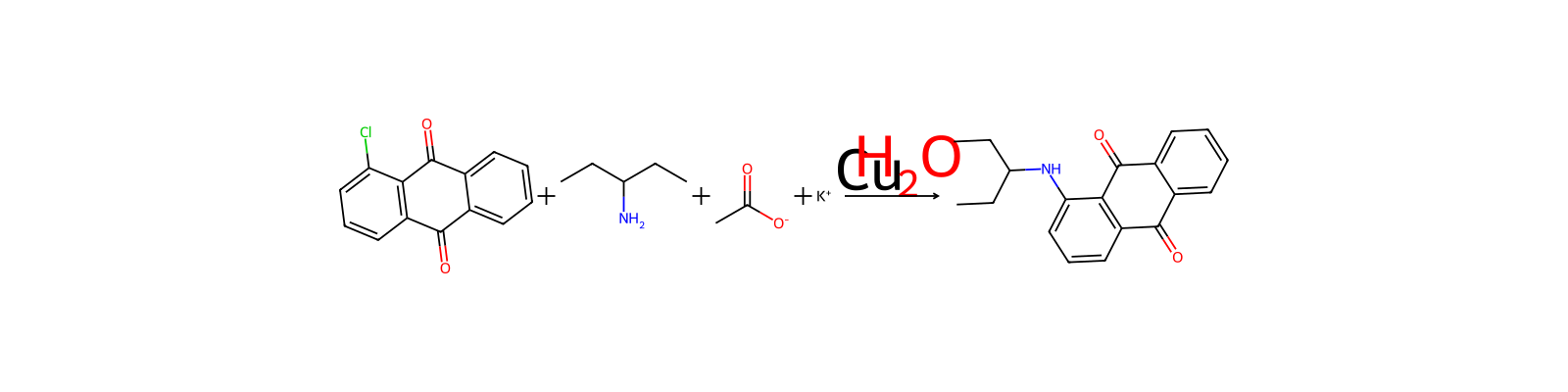
HRID 256135 reaction equation
HRID 256135As reactantuspto-grants-1987_10
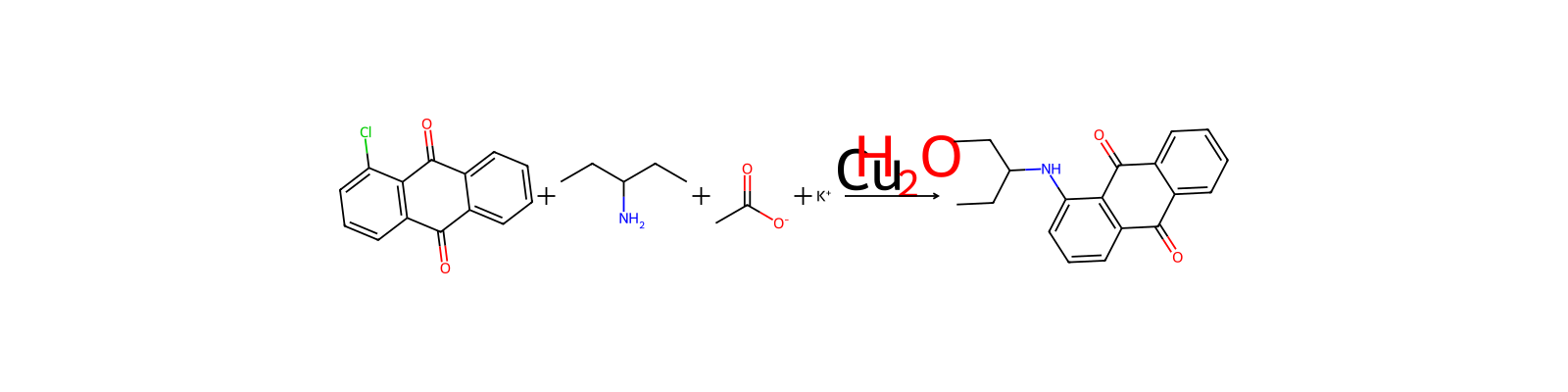
HRID 256278 reaction equation
HRID 256278As reactantuspto-grants-1987_10
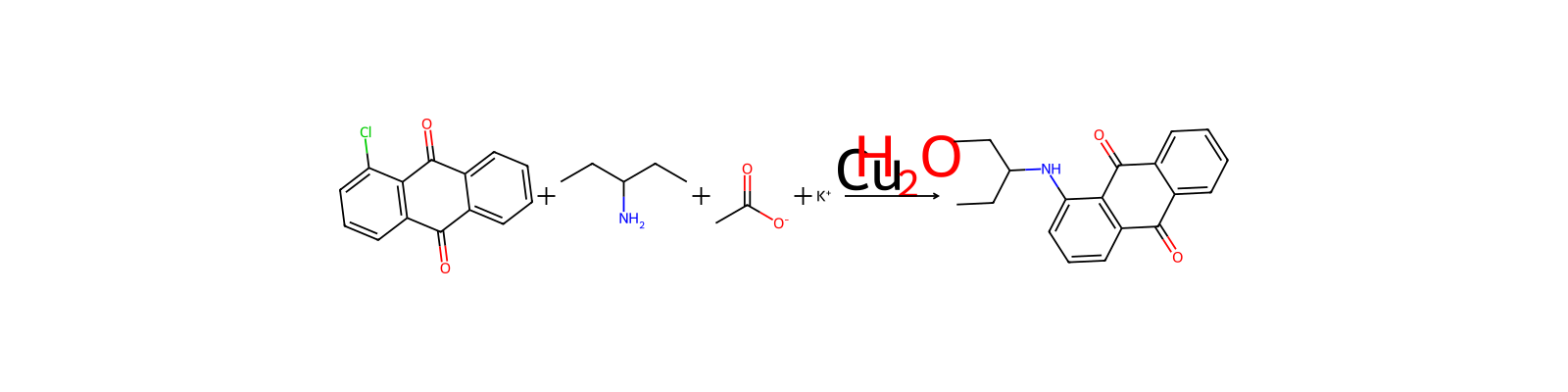
HRID 260814 reaction equation
HRID 260814As reactantuspto-grants-1996_06
HRID 260815 reaction equation
HRID 260815As reactantuspto-grants-1996_06
HRID 260817 reaction equation
HRID 260817As reactantuspto-grants-1996_06
HRID 441106 reaction equation
HRID 441106As reactantuspto-grants-1996_05
HRID 496966 reaction equation
HRID 496966As reactantuspto-grants-2005_09
Page 1 of 4

Compound notes

Loading…

On this pageBasic informationNames & identifiersPropertiesSafety & regulationChemistry & industryRelated reactionsCompound notes
More actions
New noteNew reactionRequest quotes
Other Experimental Properties
UV: 15813 (Sadtler Research Laboratories Spectral Collection) /2-Chloroanthraquinone/

Physicochemical properties

Melting point
159 · 159-160 °C (lit.)
Boiling point
345.65 °C · 345.65°C (rough estimate)
Density
1.2377 · 1.2377 (rough estimate)
refractive index
1.538 · 1.5380 (estimate)
storage temp.
30 °C · Store below +30°C.
solubility
Soluble in hot toluene. (almost transparency)
form
Powder or Chunks
color
Light yellow to yellow
BRN
1912752 · 1912752
Henry's Law Constant
4.3 · 4.3×102 mol/(m3Pa) at 25℃, Abraham and Jr. (2019)
InChI
InChI=1S/C14H7ClO2/c15-11-7-3-6-10-12(11)14(17)9-5-2-1-4-8(9)13(10)16/h1-7H
InChIKey
BOCJQSFSGAZAPQ-UHFFFAOYSA-N
SMILES
C1(Cl)=C2C(C(=O)C3=C(C2=O)C=CC=C3)=CC=C1
CAS DataBase Reference
82 · 82-44-0(CAS DataBase Reference)
EWG's Food Scores
1 · 1
FDA UNII
96 S5SQV15V · 96S5SQV15V
NIST Chemistry Reference
9 · 9,10-Anthracenedione, 1-chloro-(82-44-0)
EPA Substance Registry System
1 · 1-Chloroanthraquinone (82-44-0)
UNSPSC Code
12352115 · 12352115
NACRES
22 · NA.22
Symbol(GHS)
7 · GHS07
Signal word
Warning
Hazard statements
315 · H315-H319-H335-H320-H412
Precautionary statements
261 · P261-P280a-P304+P340-P305+P351+P338-P405-P501a-P264-P273-P305+P351+P338+P337+P313-P501
PPE
95 · dust mask type N95 (US), Eyeshields, Gloves
Hazard Codes
Xi
Risk Statements
36 · 36/37/38
Safety Statements
26 · 26-37/39-24/25
WGK Germany
3 · 3
RTECS
6150000 · CB6150000
TSCA
TSCA listed
HS Code
29147090 · 29147090
Storage Class
11 · 11 - Combustible Solids
Hazardous Substances Data
82 · 82-44-0(Hazardous Substances Data)
Toxicity
50 orally · LD50 orally in Rabbit: 15100 mg/kg
Preventive Measures · 1 item

SRP: The scientific literature for the use of contact lenses in industry is conflicting. The benefit or detrimental effects of wearing contact lenses depend not only upon the substance, but also on factors including the form of the substance, characteristics and duration of the exposure, the uses of other eye protection equipment, and the hygiene of the lenses. However, there may be individual substances whose irritating or corrosive properties are such that the wearing of contact lenses would be harmful to the eye. In those specific cases, contact lenses should not be worn. In any event, the usual eye protection equipment should be worn even when contact lenses are in place.

Toxicology

Environmental Fate · 3 items

TERRESTRIAL FATE: An estimated Koc value of 3500(1,SRC), based on an estimated log Kow of 3.99(2,SRC) suggests that 1-chloroanthraquinone will have only slight mobility in soil(SRC), based upon a recommended classification scheme(3). Under reducing conditions, this compound has been shown to form the chloroanthrone with measured half-lives of <0.4 to 2.4 daysin sediments(4) and this may also occur in soils(SRC). Incomplete information is available regarding the biodegradation potential of 1-chloroanthraquinone; however, this compound was resistant to biodegradation under aerobic conditions using an activated sludge inoculum; only 2.8% of the theoretical BOD was reported following 2 weeks incubation(5). 1-Chloroanthraquinone is not expected to volatilize from moist soil surfaces based on an estimated Henry's Law constant of 2.4X10⁻⁹ atm-cu m/mole(6,SRC).

AQUATIC FATE: Based upon an estimated Koc value of 3500(SRC) from an estimated log Kow(2,SRC), 1-chloroanthraquinone may adsorb to suspended solids and sediments(SRC) based upon a recommended classification scheme(1). In anoxic sediments, 1-chloroanthraquinone has been shown to quickly reduce resulting in the formation of an unspecified chloroanthrone(4). Half-lives of <0.4 to 2.4 days are reported for this compound dependent on the source of the sediment(4). An estimated BCF value of 630(3,SRC), based on an estimated log Kow(2,SRC) and measured BCF values of 118-351 in carp(5) indicate that 1-chloroanthraquinone may bioconcentrate in aquatic organisms(SRC). Incomplete information is available regarding the biodegradation potential of 1-chloroanthraquinone; however, this compound was resistant to biodegradation under aerobic conditions using an activated sludge inoculum; only 2.8% of theoretical BOD was reported following 2 weeks incubation(5). 1-Chloroanthraquinone is not expected to volatilize from water surfaces based on an estimated Henry's Law constant of 2.2X10⁻¹² atm-cu m/mole(SRC), developed using a fragment constant method(6).

ATMOSPHERIC FATE: Based on an estimated vapor pressure value of 8.74X10⁻⁷ mm Hg at 25 °C(1,SRC), 1-chloroanthraquinone will exist in both the vapor phase and the particulate phase in the ambient atmosphere(2,SRC). 1-Chloroanthraquinone will degrade fairly rapidly in the vapor phase by reaction with photochemically produced hydroxyl radicals with an estimated half-life of about 13 days(3,SRC). Particulate phase 1-chloroanthraquinone may be physically removed from the air by wet and dry deposition(SRC).

Adverse EffectsOccupational hepatotoxin - Secondary hepatotoxins: the potential for toxic effect in the occupational setting is based on cases of poisoning by human ingestion or animal experimentation.
Effluent Concentrations1-Chloroanthraquinone was detected in an extract of flyash from a municipal incinerator in Ontario, Canada at unreported concentrations(1).
Soil Adsorption/Mobility · 1 item

Based on an estimated log Kow of 3.99(1,SRC), the Koc of 1-chloroanthraquinone is estimated as approximately 3500(SRC) using a regression-derived equation(2). According to a suggested classification scheme(3), this estimated Koc value suggests that 1-chloroanthraquinone will have only slight mobility in soil(SRC).

Human Toxicity Excerpts · 2 items

CAUTION: LOW SYSTEMIC TOXICITY, BUT MAY CAUSE SKIN IRRITATION, SENSITIZATION. /ANTHRAQUINONE/

Chronic neurotoxic effects include vision disturbances. /From table; Quinones/

Artificial Pollution Sources · 2 items

WASTE WATERS FROM ALPHA-DISULFATION OF ANTHRAQUINONE, WHICH CONTAIN ANTHRAQUINONESULFONIC ACIDS, ARE TREATED TO FORM HALOANTHRAQUINONES.

1-Chloroanthraquinone's production and subsequent use as an intermediate in the production of dyes, including Disperse Red 9, Disperse Red 22, Vat Brown 1, Vat Brown 44, Vat Yellow 28(1), may result in its release to the environment through various waste streams(SRC).

Environmental Biodegradation1-Chloroanthraquinone (100 mg/l), inoculated with activated sludge, had a theoretical BOD of 2.8% after a two week period(1). This suggests that 1-chloroanthraquinone may be resistant to biodegradation(1).
Environmental Bioconcentration · 1 item

Experimental BCF values of 118-351 were measured using carp(1). An estimated BCF value of 630 was calculated for 1-chloroanthraquinone(SRC), using an estimated log Kow of 3.99(2,SRC) and a recommended regression-derived equation(3). These BCF values suggest that 1-chloroanthraquinone may bioconcentrate in aquatic organisms(SRC).

Volatilization from Water/SoilThe Henry's Law constant for 1-chloroanthraquinone is estimated as 2.36X10⁻⁹ atm-cu m/mole(1,SRC). This indicates that 1-chloroanthraquinone will essentially not volatilize from water surfaces(2,SRC).
Non-Human Toxicity Excerpts · 4 items

...MICE...UNHARMED BY SINGLE ORAL DOSES OF 5,000 MG/KG. /ANTHRAQUINONE/

ANTHRAQUINONE...HAS BEEN NOTED ONLY IN EXPTL ANIMAL EYES TO CAUSE IRRITATION & INFLAMMATION WHEN APPLIED TO THE EYE. ...IT IS POSSIBLE THAT IRRITATION IS DUE TO MECH ACTION OF POWDER RATHER THAN TO TOXIC EFFECT... /ANTHRAQUINONE/

Anthraquinones (incl 1-chloroanthraquinone) admin orally at 100-200 mg/kg to mice and at 200-400 mg/kg to rats were effective laxatives. Anthraquinones were weak laxatives in mice. In the range tested (100-400 mg/kg), the cmpd were not toxic in rats and mice.

Acute neurotoxic effects reported in animals include convulsions; medullary paralysis. /From table; Quinones/

Environmental Abiotic Degradation · 1 item

The rate constant for the vapor phase reaction of 1-chloroanthraquinone with photochemically produced hydroxyl radicals has been estimated as 1.3X10⁻¹² cu cm/molecule-sec at 25 °C(1). The half-life of 1-chloroanthraquinone is approximately 13 days based on a concentration of 5X10+5 hydroxyl radicals per cu cm(1,SRC). 1-Chloroanthraquinone, added to lake bottom sediments, resulted in the formation of a chlorine containing anthrone(2). 1-Chloroanthraquinone had measured first-order rate constants of 1.2X10⁻² to 6.5X10⁻²/hr giving half-lives from <0.4 to 2.4 days for this anoxic sediment-water system(2).

Environmental Fate/Exposure Summary · 1 item

1-Chloroanthraquinone's production and subsequent use as an intermediate in the production of dyes may result in its release to the environment through various waste streams. 1-Chloroanthraquinone may also be introduced directly to the environment as a product of the treatment of waste waters from the alpha-disulfation of anthraquinone. If released to the atmosphere, 1-chloroanthraquinone should exist in both the vapor phase and the particulate phase based on an estimated vapor pressure of 8.7X10⁻⁷ mm Hg. In the vapor phase, 1-chloroanthraquinone will react with hydroxyl radicals with an estimated half-life of about 13 days. Particulate phase 1-chloroanthraquinone may be physically removed from the atmosphere by wet and dry deposition. An estimated Koc of 3500 suggests that 1-chloroanthraquinone will have only slight mobility in soil. It is not expected to volatilize from moist soil surfaces given an estimated Henry's Law constant of 2.4X10⁻⁹ atm-cu m/mol. Incomplete information is available regarding the biodegradation potential of 1-chloroanthraquinone; however, this compound was resistant to biodegradation under aerobic conditions using an activated sludge inoculum; only 2.8% BOD was reported following 2 weeks incubation. In water, 1-chloroanthraquinone is expected to adsorb to organic matter and suspended solids in the water column based on its Koc value. In reducing sediments, this compound will rapidly form the chloroanthrone with measured half-lives for the parent compound of <0.4 to 2.4 days. 1-Chloroanthraquinone may bioconcentrate in aquatic organisms; BCF values of 118-351 were measured in carp, an estimated BCF value of 630 was calculated using an estimated log Kow. (SRC)

Safety data

PPE
dust mask type N95 (US), Eyeshields, Gloves
wgk
3
tsca
TSCA listed
rtecs
CB6150000
hs_code
29147090
Toxicity
LD50 orally in Rabbit: 15100 mg/kg
risk_code
36/37/38
Signal word
Warning
Symbol(GHS)
GHS07
hazard_code
Xi
safety_code
26-37/39-24/25
Storage Class
11 - Combustible Solids
Hazard statements
H315-H319-H335-H320-H412
Precautionary statements
P261-P280a-P304+P340-P305+P351+P338-P405-P501a-P264-P273-P305+P351+P338+P337+P313-P501
Hazardous Substances Data
82-44-0(Hazardous Substances Data)

Upstream raw materials

1-Anthraquinonesulfonic acid sodium saltSodium sulfiteAnthraquinoneSodium chlorate9(10H)-Anthracenone, 4-chloro-1-Anthracenecarboxylic acid, 4-chloro-9,10-dihydro-9,10-dioxo-2-Benzoyl-3-chlorobenzoic acid1-chloroanthracen-9(10H)-onepotassium 9,10-dihydro-9,10-dioxoanthracene-1-sulphonateo-Phenanthroline monohydrochloride monohydrate1,5-DICHLOROANTHRAQUINONE3-Chloro-N-phenylbenzaMide, 97%3-CHLOROPHTHALIC ANHYDRIDE

Downstream products

Vat Orange 166,10,12-trichloronaphth[2,3-c]acridine-5,8,14(13H)-trioneVAT BLACK 27Disperse Red 9Vat Orange 11Vat Brown 11,9-Pyrazoloanthrone6,10,12-trichloronaphth[2,3-c]acridine-5,8,14(13H)-trioneSolvent Red 138