Reaction equation
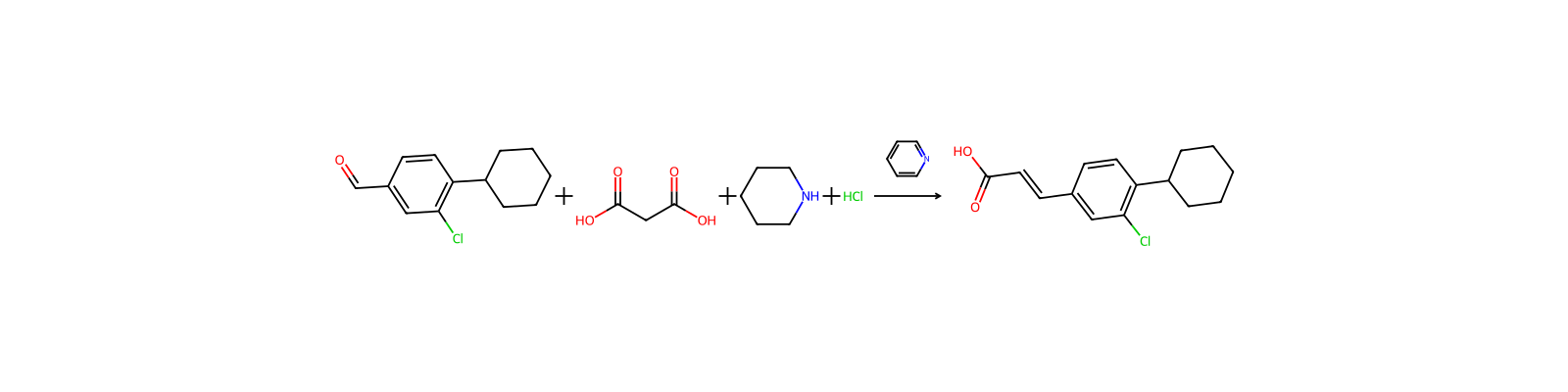
[Cl:1][C:2]1[CH:3]=[C:4]([CH:7]=[CH:8][C:9]=1[CH:10]1[CH2:15][CH2:14][CH2:13][CH2:12][CH2:11]1)[CH:5]=O.C(O)(=O)[CH2:17][C:18]([OH:20])=[O:19].N1CCCCC1.Cl>N1C=CC=CC=1>[Cl:1][C:2]1[CH:3]=[C:4]([CH:7]=[CH:8][C:9]=1[CH:10]1[CH2:15][CH2:14][CH2:13][CH2:12][CH2:11]1)[CH:5]=[CH:17][C:18]([OH:20])=[O:19]Participants
6
Reactant 4




Product 1

Reagents, catalysts & solvents 1

Procedure
3-Chloro-4-cyclohexylbenzaldehyde (0.1 mole), malonic acid (0.2 moles), and dry pyridine (175 ml) are placed in a 1 l round-bottom flask. The malonic acid is dissolved by shaking on a steam bath and piperidine (0.5 ml) is added. The reaction is allowed to take place on the steam bath for 4 hours. After standing at room temperature overnight, the mixture is refluxed for 1 hour and cooled. The reaction mixture is poured into 250 ml of ice water and acidified with concentrated hydrochloric acid (80 ml) with stirring. The crystals of product are collected by filtration, washed with water (4× 150 ml) and air dried. Recrystallization from acetone-water gives 3-chloro-4-cyclohexylcinnamic acid.
Workup
- customfor 4 hours
- temperaturethe mixture is refluxed for 1 hour
- temperaturecooled
- stirringwith stirring
- filtrationThe crystals of product are collected by filtration
- washwashed with water (4× 150 ml) and air
- customdried
- customRecrystallization from acetone-water
Sources & evidence
- ORD record
- ord-3d9256a617834f628b42d114deddc829
- Source dataset
- uspto-grants-1979_04
- Patent number
- US04150148
Linked notes
Loading…