HomeMCPWorkbenchSkills
HomeWorkbenchNotificationsMe
llms.txt · MCP GuidePrivacy Policy · Terms of Service · Supportv1.8.0
  1. Home
  2. /Reaction

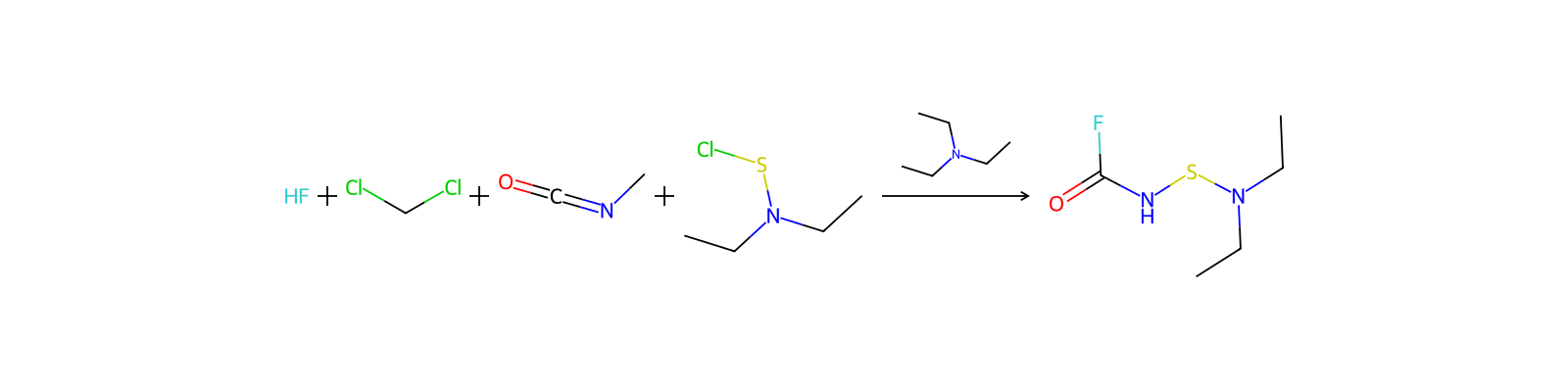
Dichloromethane → Diethylamino-sulfenyl carbamoyl fluoride

HRID 26950
Notes
Print preview

Reaction equation

HRID 26950 reaction equation
[FH:1].C(Cl)Cl.C[N:6]=[C:7]=[O:8].[CH2:9]([N:11]([CH2:14][CH3:15])[S:12]Cl)[CH3:10]>C(N(CC)CC)C>[CH2:9]([N:11]([CH2:14][CH3:15])[S:12][NH:6][C:7]([F:1])=[O:8])[CH3:10]
ParticipantsProcedureWorkupSources & evidenceReaction notes

Participants

6

Reactant 4

HCID 6344DichloromethaneHCID 12228Methyl IsocyanateHCID 14917Hydrofluoric AcidHCID 12297776N,N-diethylaminosulfenyl chloride

Product 1

HCID 131711024Diethylamino-sulfenyl carbamoyl fluorideYield 62.9%

Reagents, catalysts & solvents 1

HCID 8471
Triethylamine
Solvent

Procedure

Anhydrous hydrogen fluoride (3.0 g, 0.15 mole) was added to 150 ml of methylene chloride at -10° C. Then 8.6 g of methylisocyanate was added, followed by 20.9 g (0.15 mole) of N,N-diethylaminosulfenyl chloride at 0° C. Triethylamine (15.2 g) was then added at 0° C. over a 15-minute period, and the mixture was stirred at +5° C. for 1 hour. The mixture was then extracted with water (100 ml), saturated sodium bicarbonate solution, and water again. After drying (MgSO4), the solvent was removed in vacuo, and the crude residue was vacuum distilled to give 17 g of N-methyl-N-(diethylamino-sulfenyl carbamoyl fluoride, b.p. 57° C./0.8 mm (62.9 percent yield).

Workup

  1. extractionThe mixture was then extracted with water (100 ml), saturated sodium bicarbonate solution, and water again
  2. dry with materialAfter drying (MgSO4)
  3. customthe solvent was removed in vacuo
  4. distillationdistilled

Sources & evidence

ORD record
ord-169c72cf116c4a2a91821603167f86f8
Source dataset
uspto-grants-1979_04
DOI
10.6084/m9.figshare.5104873.v1
Patent number
US04151353

Reaction notes

Loading…

On this pageParticipantsProcedureWorkupSources & evidenceReaction notes