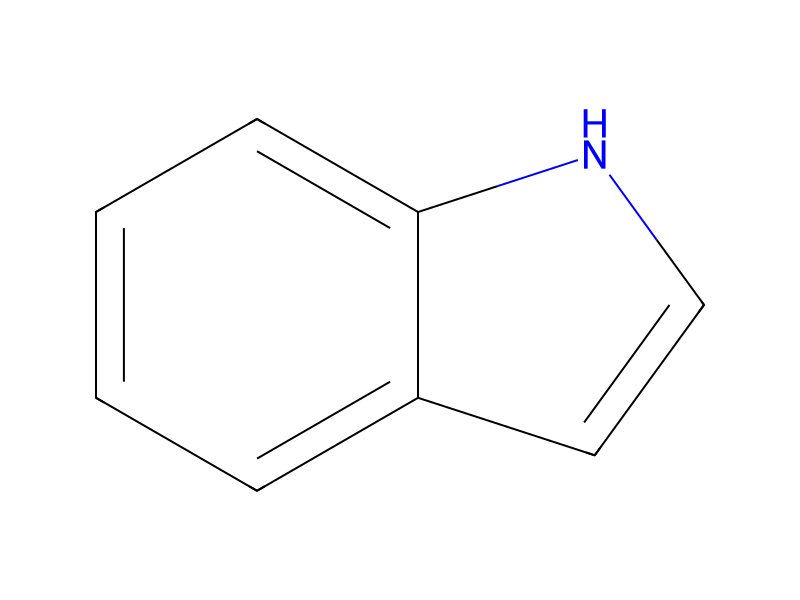
Indole → 3-Cyanoindole
HRID 269860
Reaction equation

[NH:1]1[C:9]2[C:4](=[CH:5][CH:6]=[CH:7][CH:8]=2)[CH:3]=[CH:2]1.ClS([N:14]=[C:15]=O)(=O)=O>C(N(CC)CC)C>[C:15]([C:3]1[C:4]2[C:9](=[CH:8][CH:7]=[CH:6][CH:5]=2)[NH:1][CH:2]=1)#[N:14]Participants
4
Reactant 2

Product 1

Reagents, catalysts & solvents 1

Procedure
3-Cyano analogues are synthesized from the precursor indole No. 141 as shown in Scheme 7. Reaction of the precursor indole No. 141 with chlorosulfonyl isocyanate followed by addition of triethylamine yields the 3-Cyanoindole No. 155. The side chain is made by conversion of the benzylic alcohol of CAS No. [111728-87-1] to the benzylic bromide No. 156 using thionyl bromide in THF. The indole is alkylated by the side chain in DMF using sodium hydride to give the intermediate No. 157. This can then be taken to the final product No. 138 in an analogous fashion to that shown in scheme 4.