Reaction equation
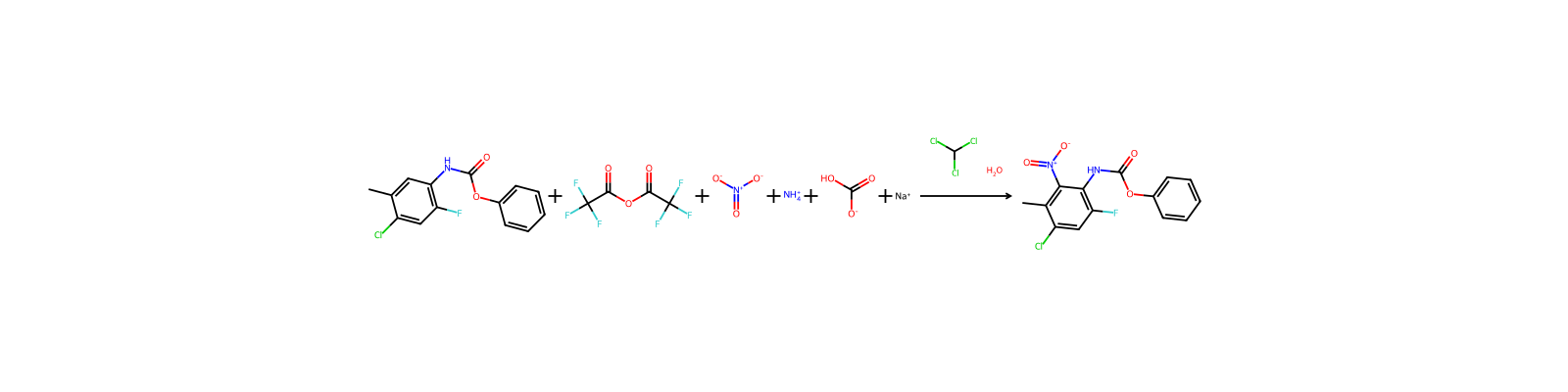
[Cl:1][C:2]1[C:17]([CH3:18])=[CH:16][C:5]([NH:6][C:7]([O:9][C:10]2[CH:15]=[CH:14][CH:13]=[CH:12][CH:11]=2)=[O:8])=[C:4]([F:19])[CH:3]=1.FC(F)(F)C(OC(=O)C(F)(F)F)=O.[N+:33]([O-])([O-:35])=[O:34].[NH4+].C(=O)(O)[O-].[Na+]>C(Cl)(Cl)Cl.O>[Cl:1][C:2]1[C:17]([CH3:18])=[C:16]([N+:33]([O-:35])=[O:34])[C:5]([NH:6][C:7]([O:9][C:10]2[CH:15]=[CH:14][CH:13]=[CH:12][CH:11]=2)=[O:8])=[C:4]([F:19])[CH:3]=1Participants
7
Reactant 4



Product 1

Reagents, catalysts & solvents 2


Procedure
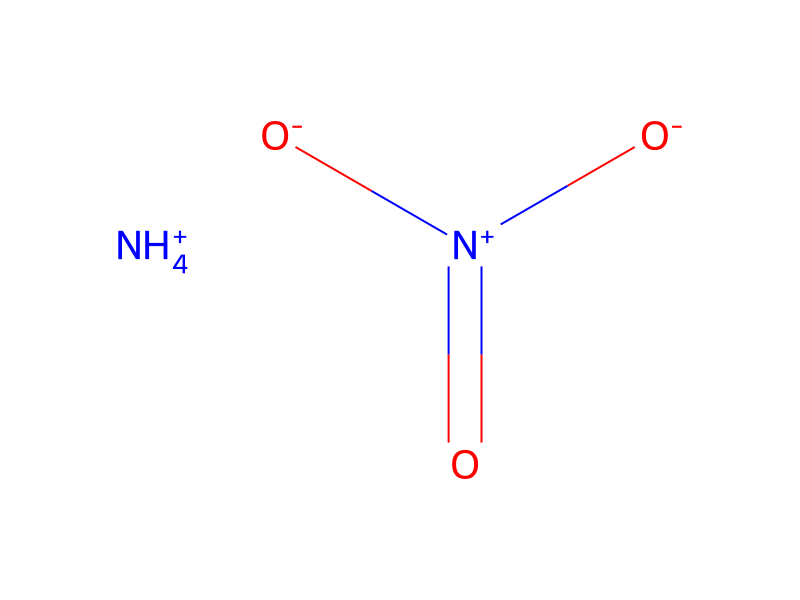
4-Chloro-2-fluoro-5-methyl-N-phenoxycarbonylaniline (7.1 g, 25.4 mmol) was dissolved in chloroform (68 ml) and trifluoroaceticanhydride (13.5 ml) and ammonium nitrate (2.4 g, 30.5 mmol) were slowly added with stirring at ambient temperature. The stirring was continued for 18 hr when a second batch of ammonium nitrate (0.4 g, 5 mmol) was added and stirring continued for 8 hr. Water was added and solution was neutralized by slow addition of sodium bicarbonate solution followed by extraction with chloroform. Organic layer was dried and evaporated under reduced pressure to afford an oily product (8.5 g) which was used for the next step without purification.
Workup
- stirringstirring
- waitcontinued for 8 hr
- extractionfollowed by extraction with chloroform
- customOrganic layer was dried
- customevaporated under reduced pressure
Sources & evidence
- ORD record
- ord-e79c080beabd48e5a7b746e48164ca14
- Source dataset
- uspto-grants-2002_03
- Patent number
- US06355799B1
Linked notes
Loading…