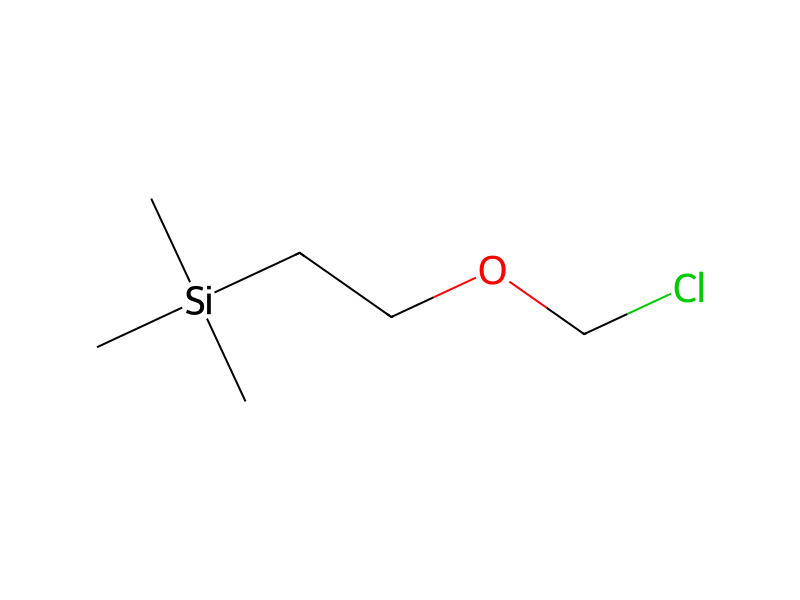
[N+:1]([C:4]1[CH:16]=[CH:15][C:7]([C:8]([C:10]2[NH:11][CH:12]=[CH:13][CH:14]=2)=[O:9])=[CH:6][CH:5]=1)([O-:3])=[O:2].[H-].[Na+].[CH3:19][Si:20]([CH3:27])([CH3:26])[CH2:21][CH2:22][O:23][CH2:24]Cl>CN(C=O)C>[N+:1]([C:4]1[CH:16]=[CH:15][C:7]([C:8]([C:10]2[N:11]([CH2:24][O:23][CH2:22][CH2:21][Si:20]([CH3:27])([CH3:26])[CH3:19])[CH:12]=[CH:13][CH:14]=2)=[O:9])=[CH:6][CH:5]=1)([O-:3])=[O:2]A solution of 2-(4-nitrobenzoyl) pyrrole (White et al., J. Org. Chem., 42 4284 [1977]; 2 g. 9.26 mM) in DMF (5 ml) was added dropwise to a stirred suspension of sodium hydride (0.42 g of a 60% dispersion in mineral oil, 1.05 mM) in DMF (15 ml). After 10 minutes, the mixture was cooled to 5° C. and 2-trimethylsilylethoxymethyl chloride (1.7 ml) was added dropwise and the mixture stirred for 10 minutes. The cooling bath was removed and stirring continued for 1.5 hours. The mixture was poured into aqueous sodium carbonate solution and extracted into EtOAc. The organic layer was washed with water, dried (MgSO4) and evaporated. The residue was purified by column chromatography in dichloromethane, eluting with a gradient increasing in polarity from 2% to 5% MeOH/dichloromethane to give 2-(4-nitrobenzoyl)-1-(2-trimethylsilylethoxymethyl)pyrrole as an oil (2.3 g). MS: 347 (MH+) NMR: −0.1 (9H, s); 0.82 (2H, t) 3.5 (2H, t); 5.71(2H, s); 6.28 (1H, m); 6.84 (1H, m); 7.52 (1H, m), 7.92 (2H, d); 8.36 (2H, d).