Reaction equation
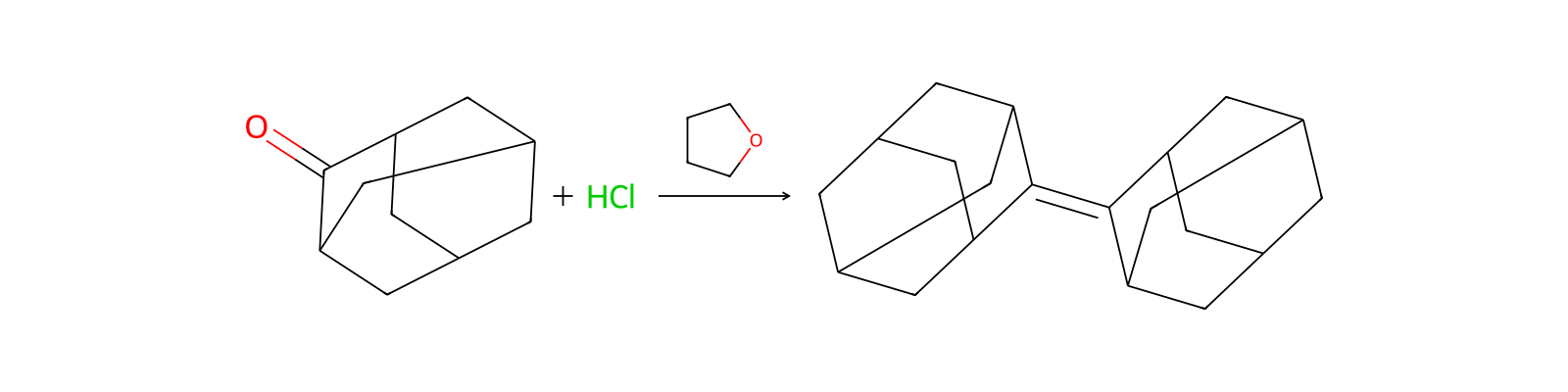
[CH:1]12[CH2:10][CH:5]3[CH2:6][CH:7]([CH2:9][CH:3]([CH2:4]3)[C:2]1=O)[CH2:8]2.Cl>O1CCCC1>[CH:1]12[CH2:10][CH:5]3[CH2:6][CH:7]([CH2:9][CH:3]([CH2:4]3)[C:2]1=[C:2]1[CH:3]3[CH2:9][CH:7]4[CH2:6][CH:5]([CH2:10][CH:1]1[CH2:8]4)[CH2:4]3)[CH2:8]2Participants
Reactant 2


Product 1

Reagents, catalysts & solvents 1

Procedure
A slurry of titanium trichloride (3.10 gm, 20.0 mmol) in 40 ml dry tetrahydrofuran was prepared under a nitrogen atmosphere, and powdered lighium aluminum hydride (380 mg, 10.0 mmol) was cautiously added. The resulting solution was stirred for one hour at room temperature to form the Ti(II) reagent, and a solution of adamantanone (1.50 gm, 10.0 mmol) in 10 ml dry Tetrahydrofuran was added. The reaction was refluxed for twelve hours, then poured into 50 ml 2 N aqueous hydrochloric acid. The solution was extracted several times with ether, and the ether extracts were combined, washed with saturated aqueous sodium chloride solution, dried over magnesium sulfate, and concentrated by solvent removal at the rotary evaporator. The resulting residue was further pruified by chromatography over silica gel. Elution with haxane gave 1.15 gm (85% yield) adamantylideneadamantane, identified by its spectral properties (infra-red, mass spectrum, and nuclear magnetic resonance), and by its melting point: mp 185°-186°.
Workup
- temperatureThe reaction was refluxed for twelve hours
- extractionThe solution was extracted several times with ether
- washwashed with saturated aqueous sodium chloride solution
- dry with materialdried over magnesium sulfate
- concentrationconcentrated by solvent removal at the rotary evaporator
- washElution with haxane
Sources & evidence
- ORD record
- ord-603ffb8a6c894f86895997e7799a18be
- Source dataset
- uspto-grants-1980_09
- Patent number
- US04225734
Linked notes
Loading…