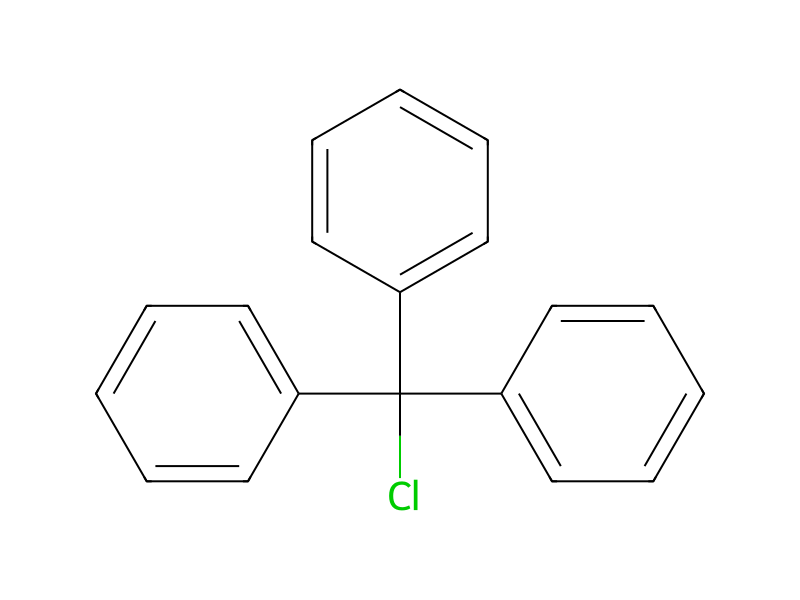
Trityl chloride → HCID 22001652, compound
HRID 324988
Reaction equation

[C:1](Cl)([C:14]1[CH:19]=[CH:18][CH:17]=[CH:16][CH:15]=1)([C:8]1[CH:13]=[CH:12][CH:11]=[CH:10][CH:9]=1)[C:2]1[CH:7]=[CH:6][CH:5]=[CH:4][CH:3]=1.[C:21]([C:24]1[CH:25]=[C:26]2[C:31](=[O:32])[NH:30][C:28](=[O:29])[C:27]2=[CH:33][CH:34]=1)([OH:23])=[O:22].CCN(C(C)C)C(C)C>C(#N)C>[C:1]([N:30]1[C:31](=[O:32])[C:26]2=[CH:25][C:24]([C:21]([OH:23])=[O:22])=[CH:34][CH:33]=[C:27]2[C:28]1=[O:29])([C:14]1[CH:19]=[CH:18][CH:17]=[CH:16][CH:15]=1)([C:8]1[CH:13]=[CH:12][CH:11]=[CH:10][CH:9]=1)[C:2]1[CH:7]=[CH:6][CH:5]=[CH:4][CH:3]=1Participants
5
Reactant 3


Product 1

Reagents, catalysts & solvents 1

Procedure
To trityl chloride resin (5 g; 10.25 retool; 200-400 mesh: 1% divinylbenzene-crosslinked polystyrene) presoaked in 80 mL dry acetonitrile for 30 min., 5 g (26 mmol) 4-carboxyphthalimide (2) from Example 2 and 6 mL (34 mmol) DIPEA were added, and the suspension was refluxed for 72 h. Following filtration, the polymer was washed with 300 mL DMF and then 300 mL CH2Cl2. The loading was determined by weight difference, and confirmed to be 0.5 mmol/g resin by TFA-induced cleavage of 4-carboxyphthalimide from the resin.