Reaction equation
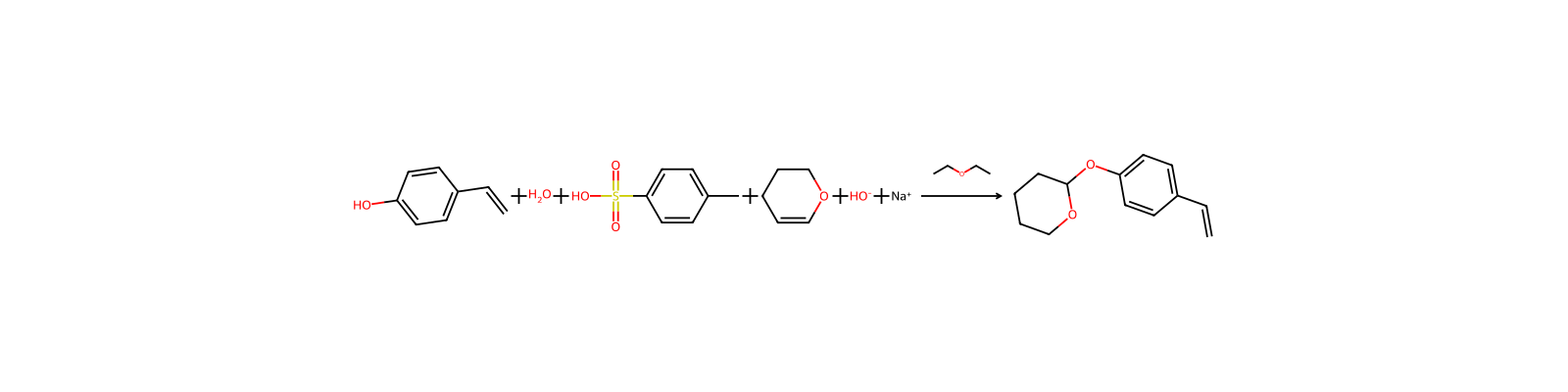
[OH:1][C:2]1[CH:9]=[CH:8][C:5]([CH:6]=[CH2:7])=[CH:4][CH:3]=1.O.C1(C)C=CC(S(O)(=O)=O)=CC=1.[O:22]1[CH:27]=[CH:26][CH2:25][CH2:24][CH2:23]1.[OH-].[Na+]>C(OCC)C>[O:22]1[CH2:27][CH2:26][CH2:25][CH2:24][CH:23]1[O:1][C:2]1[CH:9]=[CH:8][C:5]([CH:6]=[CH2:7])=[CH:4][CH:3]=1Participants
Reactant 4



Product 1

Reagents, catalysts & solvents 1

Procedure
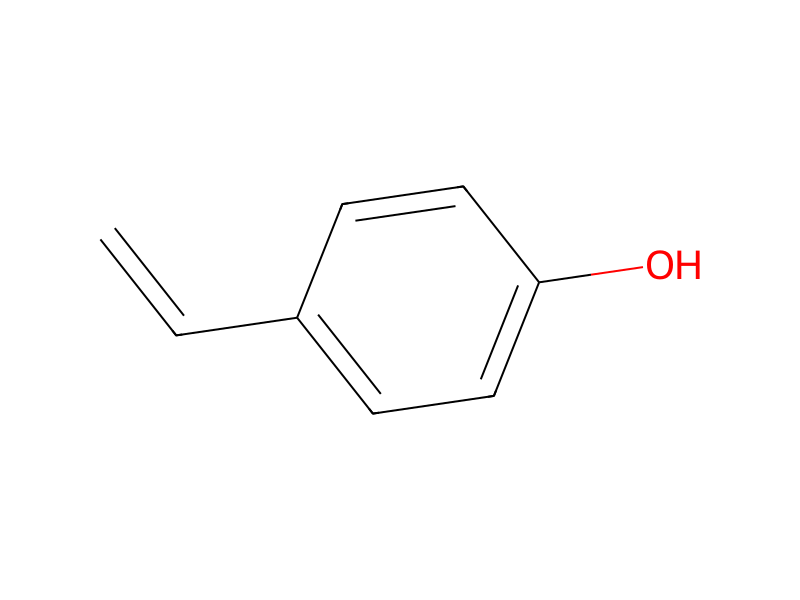
In a 250 ml round-bottomed flask, 15 g (125 mmol) of 4-hydroxystyrene and 0.4 g (2.3 mmol) of p-toluenesulfonic acid monohydrate are dissolved in 120 ml of diethyl ether. Then, at 5° C., 11.6 g (137 mmol) of 3,4-dihydro-2H-pyran are added dropwise over a period of 10 minutes. The mixture is allowed to reach room temperature and is further stirred for 20 hours. 1N NaOH solution is then added and the organic phase is washed twice with water, dried over magnesium sulfate and concentrated to yield 23.3 g (114 mmol, 90% of the theoretical yield) of 4-tetrahydropyran-2-yloxystyrene in the form of a colourless oil that can be used for the copolymerisation without being further purified. 1H-NMR (CDCl3, 100 mHz): δ7.37/d (J=9 Hz)/2H, 7.02/d (J=9 Hz)/2H, 6.52/dd (J1 =18 Hz, J2 =11 Hz)/1H, 5.50/dd (J1 =18 Hz, J2 =2 Hz)/1H, 5.41/m/1H, 5.11/dd (J1 =11 Hz, J2 =2 Hz)/1H, 4.0-3.7/m/1H, 3.7-3.4/m/1H, 2.2-1.2/m/6H.
Workup
- customto reach room temperature
- washthe organic phase is washed twice with water
- dry with materialdried over magnesium sulfate
- concentrationconcentrated
- customto yield 23.3 g (114 mmol, 90% of the
Sources & evidence
- ORD record
- ord-75947710e9094a41bdbb2a3459e26f28
- Source dataset
- uspto-grants-1993_12
- Patent number
- US05274060
Linked notes
Loading…