Reaction equation
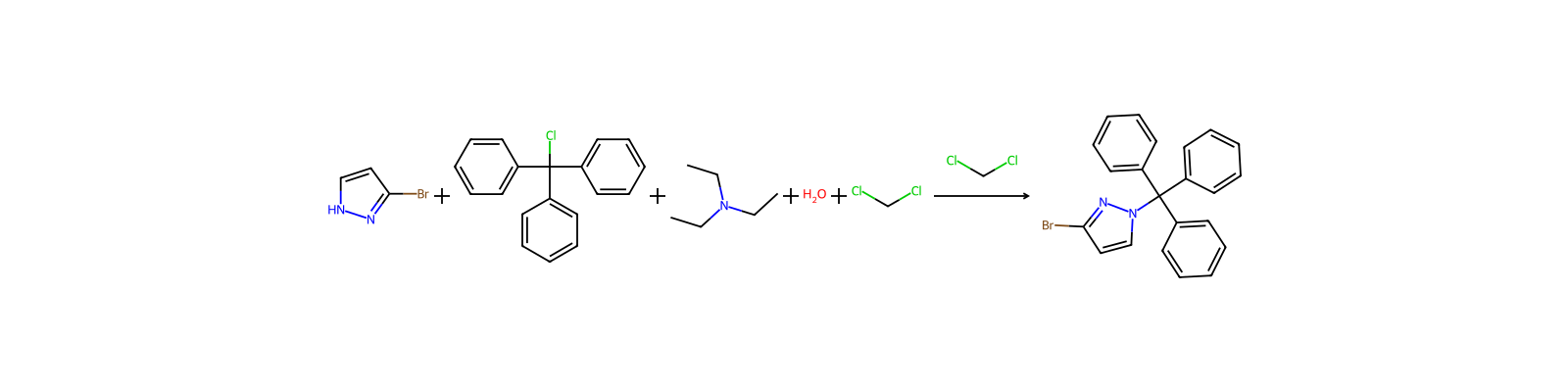
[Br:1][C:2]1[CH:6]=[CH:5][NH:4][N:3]=1.[C:7]1([C:13](Cl)([C:20]2[CH:25]=[CH:24][CH:23]=[CH:22][CH:21]=2)[C:14]2[CH:19]=[CH:18][CH:17]=[CH:16][CH:15]=2)[CH:12]=[CH:11][CH:10]=[CH:9][CH:8]=1.CCN(CC)CC.O.C(Cl)Cl>C(Cl)Cl>[Br:1][C:2]1[CH:6]=[CH:5][N:4]([C:13]([C:7]2[CH:12]=[CH:11][CH:10]=[CH:9][CH:8]=2)([C:20]2[CH:21]=[CH:22][CH:23]=[CH:24][CH:25]=2)[C:14]2[CH:15]=[CH:16][CH:17]=[CH:18][CH:19]=2)[N:3]=1Participants
6





Procedure
To a solution of 3-bromo-pyrazole (2.0 g, 13.6 mmol) in anh. CH2Cl2 (40 mL), at r.t., under N2, were added triphenylmethyl chloride (4.17 g, 1.1 eq) and Et3N (2.1 mL, 1.1 eq). The reaction mixture was stirred at r.t. for 4 hr. It was poured into water/CH2Cl2. The phases were separated and the aqueous layer was further extracted with CH2Cl2 (2×30 mL). The combined organic extracts were dried over anh. Na2SO4, the solids were filtered and the solvent evaporated. The residue was purified by flash chromatography (silica gel, 100% CH2Cl2) to give the title compound as a white solid (3.39 g, 64%).
Workup
- customThe phases were separated
- extractionthe aqueous layer was further extracted with CH2Cl2 (2×30 mL)
- dry with materialThe combined organic extracts were dried over anh. Na2SO4
- filtrationthe solids were filtered
- customthe solvent evaporated
- customThe residue was purified by flash chromatography (silica gel, 100% CH2Cl2)
Sources & evidence
- ORD record
- ord-617ef31056a84a9fb21cf436620f582e
- Source dataset
- uspto-grants-2008_09
- Patent number
- US07427630B2
Linked notes
Loading…