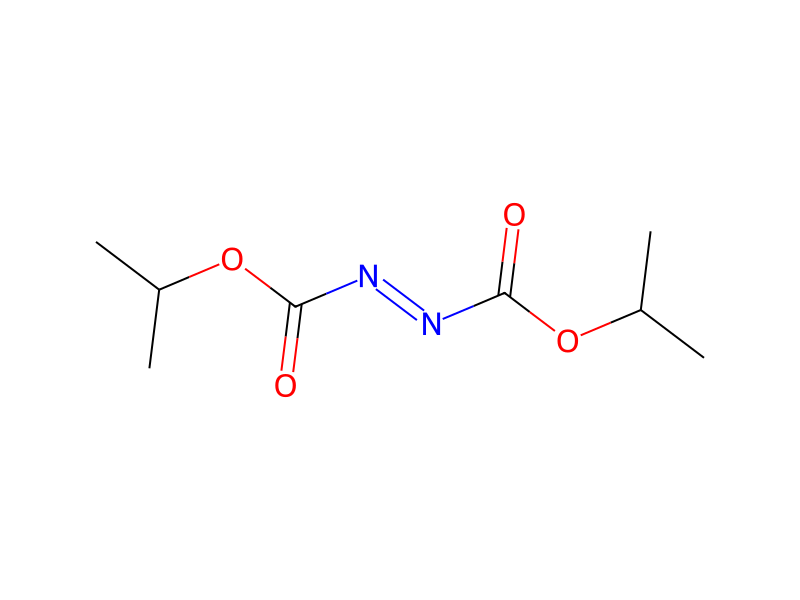
[OH:1][C:2]1[CH:3]=[N:4][C:5]([C:8]2[CH:9]=[C:10]([CH:15]=[CH:16][CH:17]=2)[C:11]([O:13][CH3:14])=[O:12])=[N:6][CH:7]=1.C1(P(C2C=CC=CC=2)C2C=CC=CC=2)C=CC=CC=1.[N:37]1([CH2:43][CH2:44]O)[CH2:42][CH2:41][O:40][CH2:39][CH2:38]1.N(C(OC(C)C)=O)=NC(OC(C)C)=O>C1COCC1>[N:37]1([CH2:43][CH2:44][O:1][C:2]2[CH:7]=[N:6][C:5]([C:8]3[CH:9]=[C:10]([CH:15]=[CH:16][CH:17]=3)[C:11]([O:13][CH3:14])=[O:12])=[N:4][CH:3]=2)[CH2:42][CH2:41][O:40][CH2:39][CH2:38]1A solution, kept under nitrogen, of 10.1 g (44 mmol) of methyl 3-(5-hydroxypyrimidin-2-yl)benzoate, 17.3 g (66 mmol) of triphenylphosphine and 5.9 ml (48.4 mmol) of 2-morpholin-4-ylethanol in 100 ml of THF is cooled in an ice bath, and 12.95 ml (66 mmol) of diisopropyl azodicarboxylate are slowly added dropwise with stirring. After stirring at room temperature for 2 hours, the reaction mixture is evaporated in vacuo. The residue is taken up in 100 ml of dichloromethane and 100 ml of water. The organic phase is dried over sodium sulfate and evaporated. The residue is recrystallised from isopropanol: methyl 3-[5-(2-morpholin-4-ylethoxy)pyrimidin-2-yl]benzoate as beige crystals; m.p. 89-91°; ESI 344 (M+H); HPLC: 2.06 min (method A).