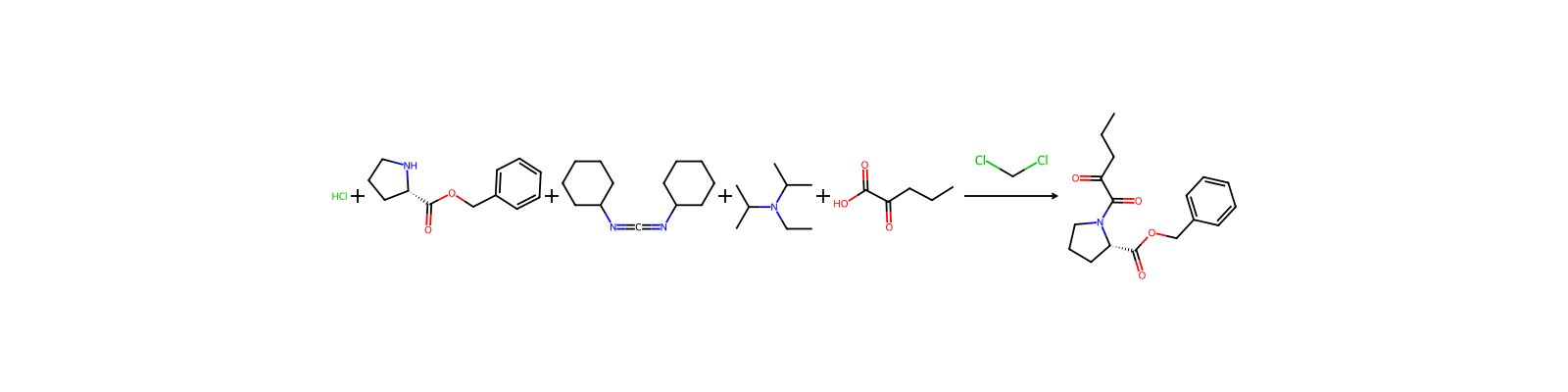
Cl.[NH:2]1[CH2:16][CH2:15][CH2:14][C@H:3]1[C:4]([O:6][CH2:7][C:8]1[CH:13]=[CH:12][CH:11]=[CH:10][CH:9]=1)=[O:5].C1(N=C=NC2CCCCC2)CCCCC1.C(N(C(C)C)CC)(C)C.[O:41]=[C:42]([CH2:46][CH2:47][CH3:48])[C:43](O)=[O:44]>ClCCl>[O:41]=[C:42]([CH2:46][CH2:47][CH3:48])[C:43]([N:2]1[CH2:16][CH2:15][CH2:14][C@H:3]1[C:4]([O:6][CH2:7][C:8]1[CH:9]=[CH:10][CH:11]=[CH:12][CH:13]=1)=[O:5])=[O:44]8.8 g benzyl prolinate hydrochloride, 9.78 g dicyclohexylcarbodiimide and 6.12 g diisopropylethylamine were reacted together in 50 mL dichloromethane at 0°. 5.51 g 2-oxopentanoic acid in 10 mL dichloromethane was added dropwise at 0°. The pH of the reaction was adjusted to between 8 and 9 with diisopropylethylamine. The reaction mixture was stirred for four hours at 0°, then room temperature overnight. The next day, the reaction mixture was filtered, concentrated to dryness, and partitioned between ethyl acetate and water. The organic layer was washed with 5% sodium bisulfate, 5% sodium bicarbonate, and saturated sodium chloride solutions, and dried with magnesium sulfate. The organic layer was concentrated to give a yellow oil. The oil was then passed through a silica gel column and eluted with ethyl acetate/hexane (4:6) and ethyl acetate/hexane (1:1). Benzyl N-(2-oxopentanoyl)prolinate, [α]D25 -56.9, was isolated.
Loading…