HomeMCPWorkbenchSkills
HomeWorkbenchNotificationsMe
llms.txt · MCP GuidePrivacy Policy · Terms of Service · Supportv1.8.3
  1. Home
  2. /Reaction

Triphenylphosphine → methyl (S)-3-chloro-4-(2-amino-1-propoxy)benzoate

HRID 350551
Print

Reaction equation

HRID 350551 reaction equation
C(OC([NH:8][C@@H:9]([CH3:12])[CH2:10][OH:11])=O)(C)(C)C.[Cl:13][C:14]1[CH:15]=[C:16]([CH:21]=[CH:22][C:23]=1O)[C:17]([O:19][CH3:20])=[O:18].C1C=CC(P(C2C=CC=CC=2)C2C=CC=CC=2)=CC=1.N(C(OC(C)C)=O)=NC(OC(C)C)=O>C1COCC1>[Cl:13][C:14]1[CH:15]=[C:16]([CH:21]=[CH:22][C:23]=1[O:11][CH2:10][C@@H:9]([NH2:8])[CH3:12])[C:17]([O:19][CH3:20])=[O:18]
ParticipantsProcedureWorkupSources & evidenceReaction notes

Participants

6

Reactant 4

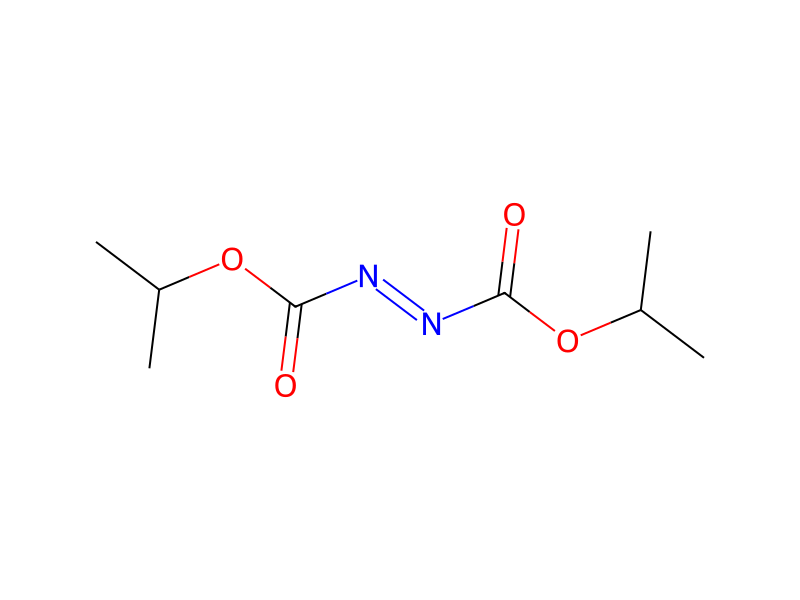
HCID 11776TriphenylphosphineHCID 75555Diisopropyl diazene-1,2-dicarboxylateHCID 77580Methyl 3-chloro-4-hydroxybenzoateHCID 70231031,1-Dimethylethyl N-((1S)-2-hydroxy-1-methylethyl)carbamate

Product 1

HCID 86587793methyl (S)-3-chloro-4-(2-amino-1-propoxy)benzoateYield 45.2%

Reagents, catalysts & solvents

1
HCID 8028TetrahydrofuranSolvent

Procedure

To a cooled (0° C.) solution of (S)-2-(N-tert-butoxycarbonylamino)-1-propanol (1.05 g, 5.99 mmol), methyl 3-chloro-4-hydroxybenzoate (1.12 g, 6.00 mmol), and Ph3P (2.36 g, 9.00 mmol) in THF (20 mL) was added diisopropyl azodicarboxylate (DIAD) (1.77 mL, 8.99 mmol), and the resulting mixture was heated under reflux for 2 days. The solution was evaporated off and the residue was dissolved in CH2Cl2 (20 mL) and TFA (10 mL). The resulting mixture was stirred at room temp for 1.5 hr. The solution was concentrated in vacuo, and the residue was dissolved in CHCl3. The mixture was extracted with H2O, and the aqueous layer was made basic by the addition of sat. NaHCO3. This basic aqueous layer was extracted with CHCl3. The extract was washed with brine, dried over Na2SO4 and evaporated to give 660 mg (2 steps, 32%) methyl (S)-3-chloro-4-(2-amino-1-propoxy)benzoate as a colorless oil. 1H-NMR (CDCl3) δ 1.21 (d, 3 H, J=6.4 Hz), 3.41–3.48 (m, 1 H), 3.77–3.81 (m, 1 H), 3.89 (s, 3 H), 3.98–4.01 (m, 1 H), 6.91–6.94 (m, 1 H), 7.90–7.93 (m, 1 H), 8.05–8.06 (m, 1 H).


Workup

  1. temperaturethe resulting mixture was heated
  2. temperatureunder reflux for 2 days
  3. customThe solution was evaporated off
  4. dissolutionthe residue was dissolved in CH2Cl2 (20 mL)
  5. concentrationThe solution was concentrated in vacuo
  6. dissolutionthe residue was dissolved in CHCl3
  7. extractionThe mixture was extracted with H2O
  8. additionthe aqueous layer was made basic by the addition of sat. NaHCO3
  9. extractionThis basic aqueous layer was extracted with CHCl3
  10. washThe extract was washed with brine
  11. dry with materialdried over Na2SO4
  12. customevaporated

Sources & evidence

ORD record
ord-a8d8d4e4546548a1984e3697f8c32deb
Source dataset
uspto-grants-2007_02
DOI
10.6084/m9.figshare.5104873.v1
Patent number
US07179819B2

Reaction notes

On this pageParticipantsProcedureWorkupSources & evidenceReaction notes