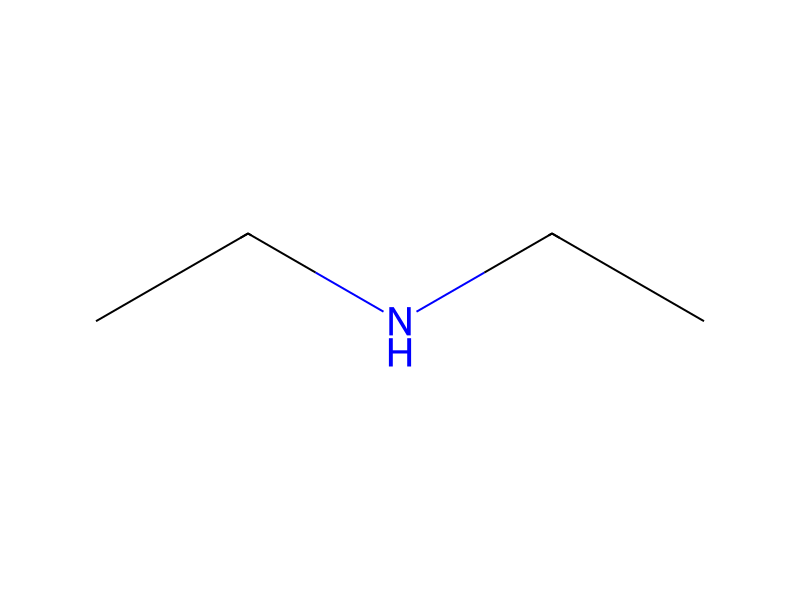
[C:1]([O:5][C:6]([N:8]1[CH2:13][CH2:12][C:11](=[C:14]([Br:24])[C:15]2[CH:20]=[CH:19][C:18]([C:21](O)=[O:22])=[CH:17][CH:16]=2)[CH2:10][CH2:9]1)=[O:7])([CH3:4])([CH3:3])[CH3:2].C(OC(Cl)=O)C(C)C.[CH2:33]([NH:35][CH2:36][CH3:37])[CH3:34]>ClCCl>[C:1]([O:5][C:6]([N:8]1[CH2:13][CH2:12][C:11](=[C:14]([Br:24])[C:15]2[CH:16]=[CH:17][C:18]([C:21](=[O:22])[N:35]([CH2:36][CH3:37])[CH2:33][CH3:34])=[CH:19][CH:20]=2)[CH2:10][CH2:9]1)=[O:7])([CH3:2])([CH3:3])[CH3:4]To a solution of compound 5 (1.0 g, 2.5 mmol) in dry dichloromethane (10 mL) at −20° C. was added isobutylchloroformate (450 mg, 3.3 mmol). After 20 min at −20° C. diethylamine (4 mL) was added and the reaction was allowed to warm to room temperature. After 1.5 hrs the solvents were evaporated and the residue was partitioned between ethyl acetate and water. The organic phase was washed with brine and dried over MgSO4. Removal of solvents provided a crude product, which was purified by flash chromatography to give compound 6 as white needles (800 mg, 73%): IR (NaCl) 3051, 2975, 1694, 1633, 1416, 1281, 1168, 1115 cm−1; 1H NMR (CDCl3) δ1.13 (br, 3H), 1.22 (br, 3H), 1.44 (s, 9H),2.22 (t, J=5.5 Hz, 2H), 2.62 (t, J=5.5 Hz, 2H), 3.33 (m, 4H), 3.55 (m, 2H), 7.31 (d, J=8.0 Hz, 2H), 7.36 (d, J=8.0 Hz, 2H); 13C NMR (CDCl3) δ12.71, 14.13, 28.3, 31.5, 34.2, 39.1, 43.2, 79.7, 115.9, 126.3, 129.3, 136.8, 137.1, 140.6, 154.6, 170.