Reaction equation
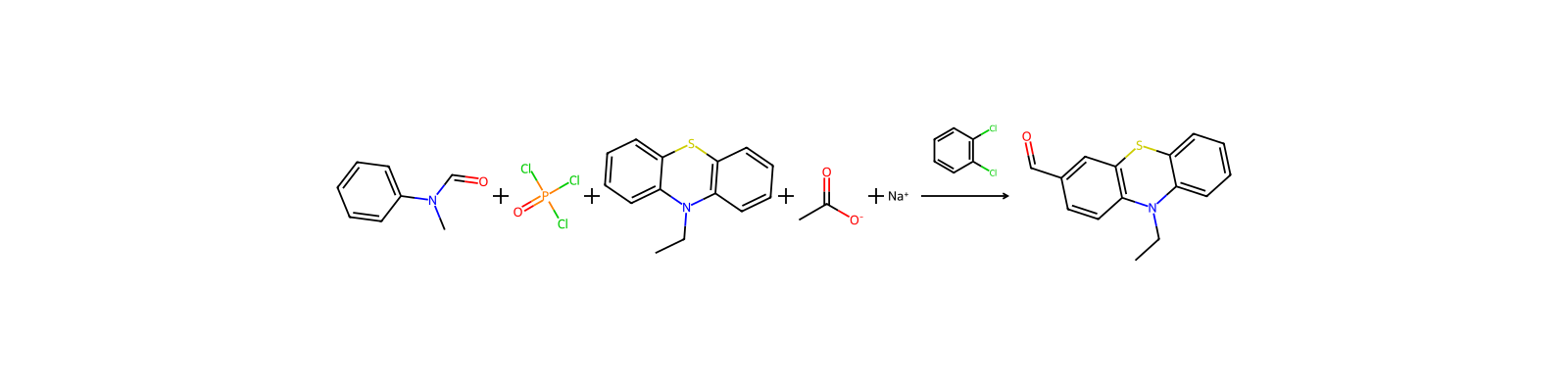
CN([CH:9]=[O:10])C1C=CC=CC=1.P(Cl)(Cl)(Cl)=O.[CH2:16]([N:18]1[C:31]2[CH:30]=[CH:29][CH:28]=[CH:27][C:26]=2[S:25][C:24]2[C:19]1=[CH:20][CH:21]=[CH:22][CH:23]=2)[CH3:17].C([O-])(=O)C.[Na+]>ClC1C=CC=CC=1Cl>[CH2:16]([N:18]1[C:19]2[CH:20]=[CH:21][C:22]([CH:9]=[O:10])=[CH:23][C:24]=2[S:25][C:26]2[C:31]1=[CH:30][CH:29]=[CH:28][CH:27]=2)[CH3:17]Participants



Conditions
- Temperature
- 100 °C
Procedure
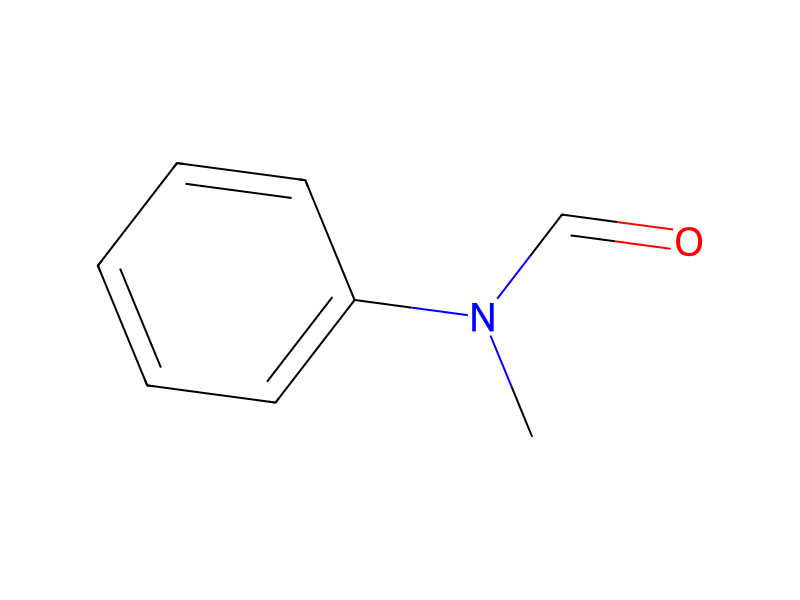
N-Methylformanilide (5.35 ml, 43.6 mmol) and phosphorus oxychloride (4.06 ml, 43.6 mmol) were added at room temperature to a mixture of 10-ethylphenothiazine (7.62 g, 33.5 mmol) and 1,2-dichlorobenzene (34 ml), and the mixture was stirred at 100° C. for 24 hours. At room temperature, a sodium acetate aqueous solution (45 wt. %, 85 g) was added to the reaction mixture, which was subsequently concentrated under a reduced pressure. Ethyl acetate and water (each 300 ml) were added to the resulting residue in that order and then the reaction product was extracted with ethyl acetate. The extract was dried over anhydrous magnesium sulfate and then concentrated under a reduced pressure. The resulting residue was purified by silica gel column chromatography (eluent; hexane:ethyl acetate=5:1) to give the title compound (5.91 g, 23.1 mmol, 69%) as yellow crystals.
Workup
- concentrationwas subsequently concentrated under a reduced pressure
- additionEthyl acetate and water (each 300 ml) were added to the resulting residue in that order
- extractionthe reaction product was extracted with ethyl acetate
- dry with materialThe extract was dried over anhydrous magnesium sulfate
- concentrationconcentrated under a reduced pressure
- customThe resulting residue was purified by silica gel column chromatography (eluent; hexane:ethyl acetate=5:1)
Sources & evidence
- ORD record
- ord-1437272821134a61a16b6222de15954f
- Source dataset
- uspto-grants-1998_11
- Patent number
- US05830902
Linked notes
Loading…