Tacrine → HCID 9819911, compound
HRID 359132
Reaction equation

[C:1](Cl)(=[O:11])[CH2:2][CH2:3][CH2:4][CH2:5][CH2:6][CH2:7][CH2:8][CH2:9][CH3:10].C(N(CC)CC)C.[CH2:20]1[C:33]2[C:24](=[N:25][C:26]3[C:31]([C:32]=2[NH2:34])=[CH:30][CH:29]=[CH:28][CH:27]=3)[CH2:23][CH2:22][CH2:21]1>C(Cl)(Cl)Cl>[CH2:30]1[C:31]2[C:26](=[N:25][C:24]3[C:33]([C:32]=2[NH:34][C:1](=[O:11])[CH2:2][CH2:3][CH2:4][CH2:5][CH2:6][CH2:7][CH2:8][CH2:9][CH3:10])=[CH:20][CH:21]=[CH:22][CH:23]=3)[CH2:27][CH2:28][CH2:29]1Participants
5
Reactant 3


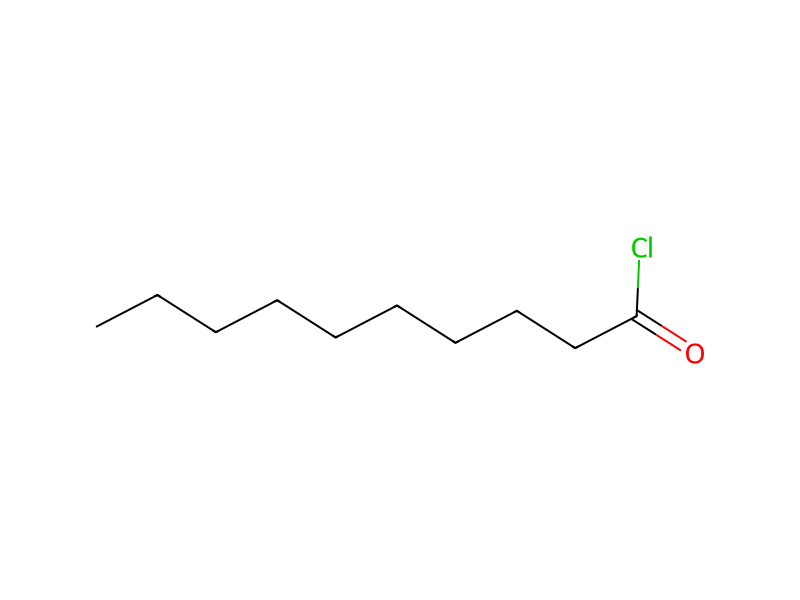
Product 1

Reagents, catalysts & solvents 1

Procedure
Freshly distilled decanoyl chloride, 5.18 g (0.029 mol), is slowly added to a mixture of 2.94 g (0.029 mol) of triethylamine and 5.82 g (0.029 mol) of 1,2,3,4-tetrahydro-9-acridinamine (Petrow, V., Journal of the Chemical Society, pages 634 to 637 (1947)) in 150 ml of Chloroform. The mixture is heated at reflux for two hours, cooled to room temperature, filtered, and the filtrate evaporated to afford, after repeated washing with diethyl ether, 1.67 g of N-(1,3,4,5-tetrahydro-9-acridinyl)decanamide as a yellow solid: mp 123-126° C.