Hydroquinone → Nitric Acid
Reaction equation

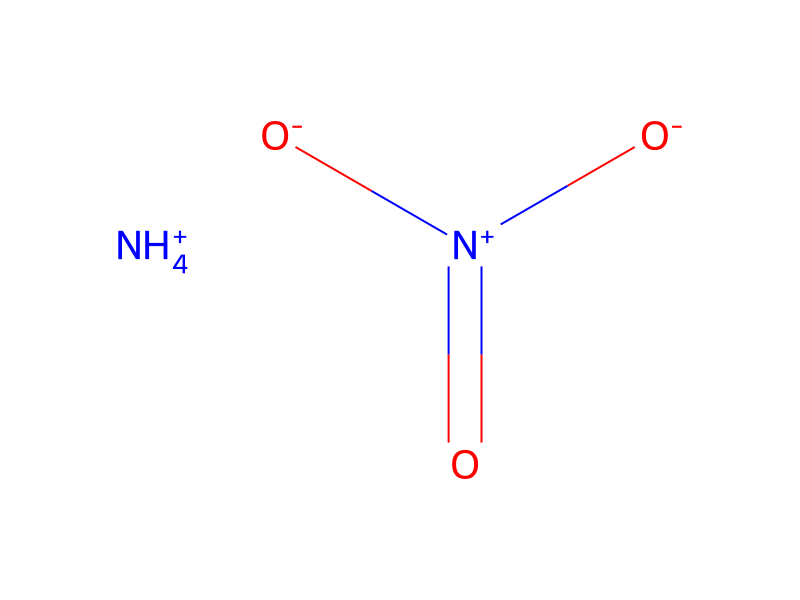
[N+:1]([O-:4])([OH:3])=[O:2].C1(C=CC(O)=CC=1)O>>[N+:1]([O-:4])([O-:3])=[O:2].[OH:2][NH3+:1].[N+:1]([O-:4])([OH:3])=[O:2].[N+:1]([O-:4])([O-:3])=[O:2].[NH4+:1]Participants
5



Procedure
The general procedure of Example 8 is repeated except that a solution of 1 M nitric acid and 100 ppm hydroquinone is charged to the catholyte compartment. A solution of 4 M nitric acid is charged to the anolyte compartment. Concentrated nitric acid is added to the catholyte compartment to maintain the nitric acid concentration between 0.5 M and 1 M under application of an electrical current. While maintaining the temperature between 5° C. and 10° C., a current of 20 amps (5 ASI) and a cell voltage of about 6.5 volts is applied. A solution of 1.3 M hydroxylammonium nitrate and 0.8 M nitric acid with no detectable ammonium nitrate is obtained from the catholyte compartment. An overall current efficiency of 60% for formation of hydroxylammonium nitrate is achieved.