HomeMCPWorkbenchSkills
HomeWorkbenchNotificationsMe
llms.txt · MCP GuidePrivacy Policy · Terms of Service · Supportv1.8.0
  1. Home
  2. /Reaction

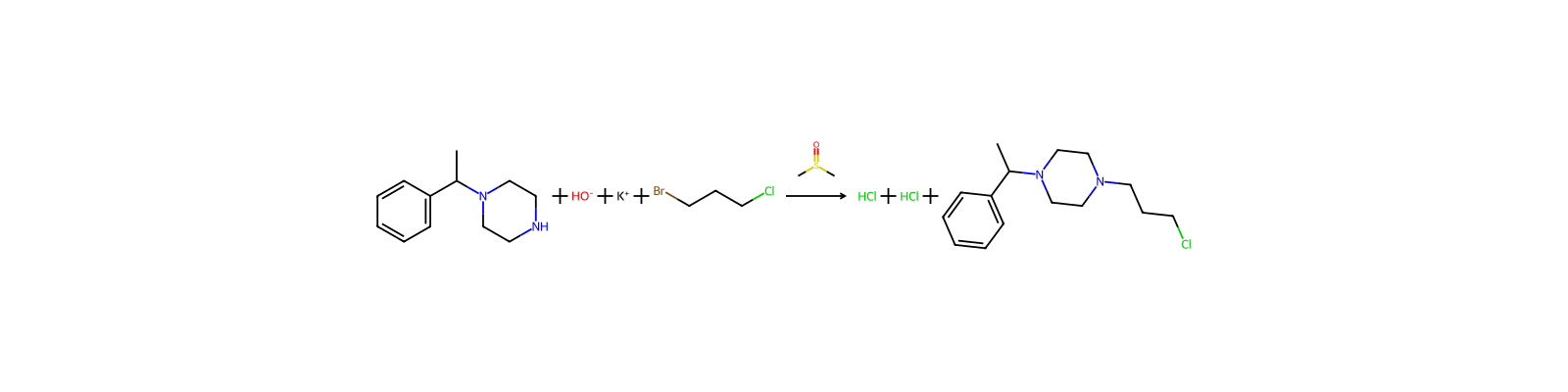
1-Bromo-3-chloropropane → 1-(1-Phenylethyl)-4-(3-chloropropyl)piperazine dihydrochloride

HRID 3812
Notes
Print preview

Reaction equation

HRID 3812 reaction equation
[C:1]1([CH:7]([N:9]2[CH2:14][CH2:13][NH:12][CH2:11][CH2:10]2)[CH3:8])[CH:6]=[CH:5][CH:4]=[CH:3][CH:2]=1.[OH-].[K+].Br[CH2:18][CH2:19][CH2:20][Cl:21]>CS(C)=O>[ClH:21].[ClH:21].[C:1]1([CH:7]([N:9]2[CH2:10][CH2:11][N:12]([CH2:18][CH2:19][CH2:20][Cl:21])[CH2:13][CH2:14]2)[CH3:8])[CH:6]=[CH:5][CH:4]=[CH:3][CH:2]=1
ParticipantsProcedureSources & evidenceReaction notes

Participants

5

Reactant 3

HCID 80061-Bromo-3-chloropropaneHCID 14797Potassium HydroxideHCID 27371341-(1-Phenylethyl)piperazine

Product 1

HCID 201531701-(1-Phenylethyl)-4-(3-chloropropyl)piperazine dihydrochlorideYield 409.8%

Reagents, catalysts & solvents 1

HCID 679Dimethyl SulfoxideSolvent

Procedure

The procedure described in Example 17(a) was followed, using 16.5 g of 1-(1-phenylethyl)piperazine, 8.0 g of potassium hydroxide, 125 ml of dimethyl sulfoxide and 9.5 g of 1-bromo-3-chloropropane. Work-up, as described above, gave 28.0 g (96% of theory) of 1-(1-phenylethyl)-4-(3-chloropropyl)piperazine dihydrochloride as a white crystalline solid.

Sources & evidence

ORD record
ord-93cf949e00b544a7b8fbd151bc44a719
Source dataset
uspto-grants-1988_02
DOI
10.6084/m9.figshare.5104873.v1
Patent number
US04722926

Reaction notes

Loading…

On this pageParticipantsProcedureSources & evidenceReaction notes