Reaction equation

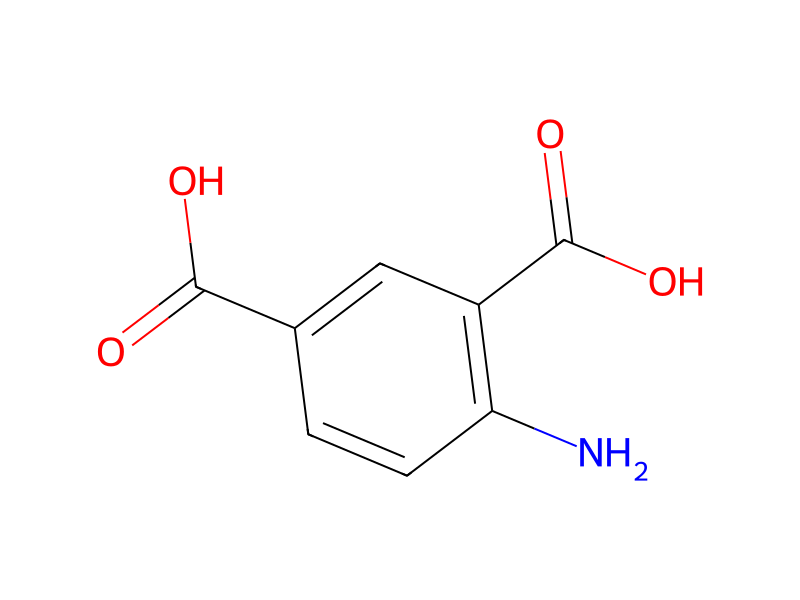
[C:1]([C:4]1[CH:12]=[C:8]([C:9](O)=[O:10])[C:7]([NH2:13])=[CH:6][CH:5]=1)([OH:3])=[O:2].[CH:14]([O-])([O-])OC.C([O-])(=O)C.[NH4+:23].Cl>O.CO>[C:1]([C:4]1[CH:12]=[C:8]2[C:7](=[CH:6][CH:5]=1)[N:13]=[CH:14][NH:23][C:9]2=[O:10])([OH:3])=[O:2]Participants
7






Procedure
In a 10-mL volume stainless steel pressure-resistant vessel were placed 1.00 g (5.5 mmol) of 5-carboxyanthranilic acid, 2.30 g (22.0 mmol) of methyl orthoformate, 1.70 g (22.0 mmol) of ammonium acetate, and 4.0 mL of methanol. The reaction was carried out at 120° C. for 3 hours. After the reaction was complete, the reaction mixture was cooled to room temperature, and 40 mL of water and 10 mL of hydrochloric acid (1 mol/L) were added to the reaction mixture. The resulting aqueous mixture was stirred for 15 minutes and filtered to give 0.96 g (isolated yield: 84%, purity: 91% in terms of area percentage determined by high performance liquid chromatography) of 6-carboxyquinazolin-4-one as a yellow crystalline product.
Workup
- customIn a 10-mL volume stainless steel pressure-resistant vessel were placed
- filtrationfiltered
Sources & evidence
- ORD record
- ord-0254755dddaa433fb2751a3513550e4f
- Source dataset
- uspto-grants-2013_02
- Patent number
- US08367824B2
Linked notes
Loading…