Reaction equation

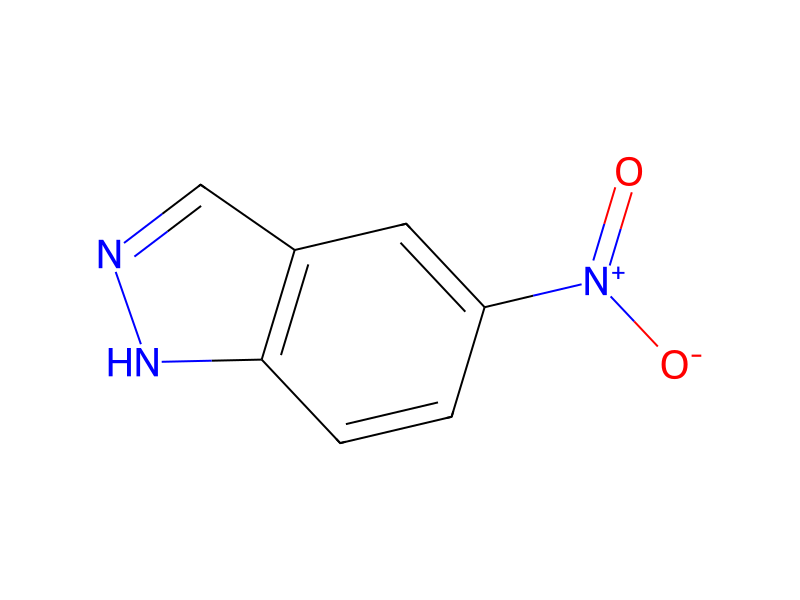
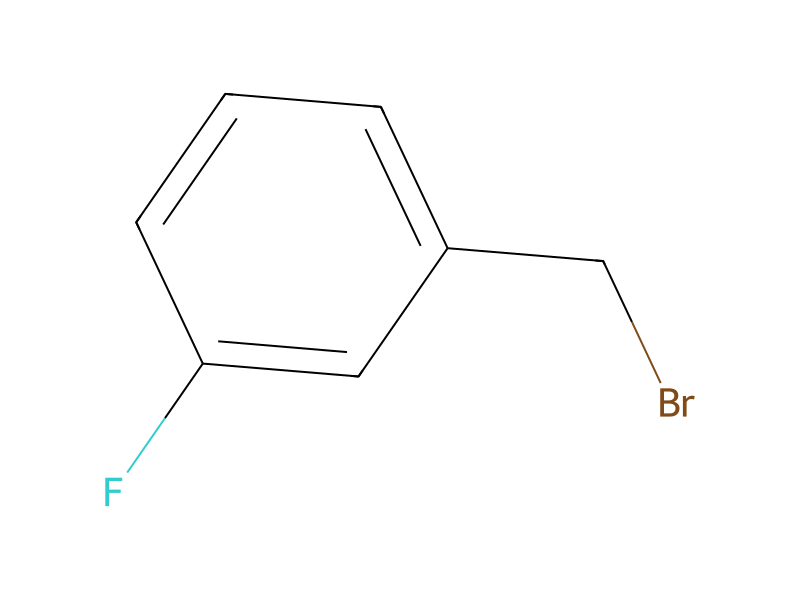
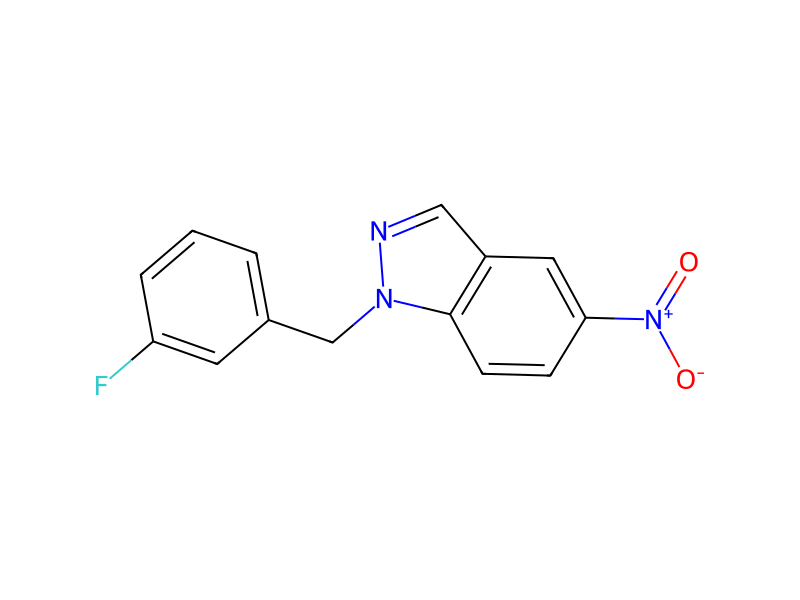
[N+:1]([C:4]1[CH:5]=[C:6]2[C:10](=[CH:11][CH:12]=1)[NH:9][N:8]=[CH:7]2)([O-:3])=[O:2].C(=O)([O-])[O-].[K+].[K+].[F:19][C:20]1[CH:21]=[C:22]([CH:25]=[CH:26][CH:27]=1)[CH2:23]Br>C1COCC1>[F:19][C:20]1[CH:21]=[C:22]([CH:25]=[CH:26][CH:27]=1)[CH2:23][N:9]1[C:10]2[C:6](=[CH:5][C:4]([N+:1]([O-:3])=[O:2])=[CH:12][CH:11]=2)[CH:7]=[N:8]1Participants
Reactant 3

Product 1
Reagents, catalysts & solvents 1

Procedure
5-Nitroindazol (10.0 g, 61.3 mmol) was dissolved in THF (100 mL). Potassium carbonate (25.4 g, 184 mmol) and 3-fluorobenzylbromide (12.7 g, 67.4 mmol) were added, and the mixture was heated to reflux for 3 h. The solvent was removed in vacuo, and the residue was dissolved in ethyl acetate (150 mL) and extracted with water (200 mL). The aqueous layer was extracted twice with ethyl acetate (100 mL each). The combined organic layers were dried over sodium sulfate, and the solvent was removed in vacuo. The residue was purified by column chromatography on silica gel (eluent: cyclohexane/ethyl acetate 3:1) to yield 6.55 g (39%) of the title compound (less polar component) and 5.84 g (35%) of the regioisomeric 2H-indazole derivative (more polar component).
Workup
- temperaturethe mixture was heated
- temperatureto reflux for 3 h
- customThe solvent was removed in vacuo
- dissolutionthe residue was dissolved in ethyl acetate (150 mL)
- extractionextracted with water (200 mL)
- extractionThe aqueous layer was extracted twice with ethyl acetate (100 mL each)
- dry with materialThe combined organic layers were dried over sodium sulfate
- customthe solvent was removed in vacuo
- customThe residue was purified by column chromatography on silica gel (eluent: cyclohexane/ethyl acetate 3:1)
Sources & evidence
- ORD record
- ord-eced96baf29e45a89f35dbfc2d2f9206
- Source dataset
- uspto-grants-2013_09
- Patent number
- US08524722B2
Linked notes
Loading…