HomeMCPWorkbenchSkills
HomeWorkbenchNotificationsMe
llms.txt · MCP GuidePrivacy Policy · Terms of Service · Supportv1.8.0
  1. Home
  2. /Reaction

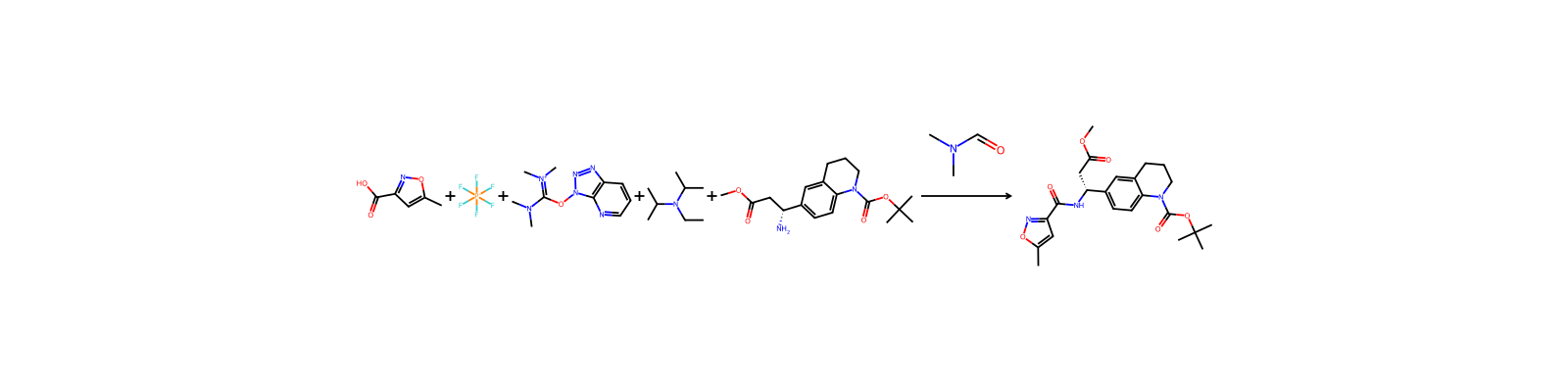
3-Methyl-5-isoxazolecarboxylic acid → Methyl (R) 3-(1-boc-1,2,3,4-Tetrahydro-quinolin-6-yl)-3-[(5-methyl-isoxazole-3-carbonyl)-amino]-propionate

HRID 396726
Notes
Print preview

Reaction equation

HRID 396726 reaction equation
[CH3:1][C:2]1[O:6][N:5]=[C:4]([C:7]([OH:9])=O)[CH:3]=1.F[P-](F)(F)(F)(F)F.N1(OC(N(C)C)=[N+](C)C)C2N=CC=CC=2N=N1.C(N(C(C)C)CC)(C)C.[NH2:43][C@@H:44]([C:50]1[CH:51]=[C:52]2[C:57](=[CH:58][CH:59]=1)[N:56]([C:60]([O:62][C:63]([CH3:66])([CH3:65])[CH3:64])=[O:61])[CH2:55][CH2:54][CH2:53]2)[CH2:45][C:46]([O:48][CH3:49])=[O:47]>CN(C)C=O>[C:60]([N:56]1[C:57]2[C:52](=[CH:51][C:50]([C@H:44]([NH:43][C:7]([C:4]3[CH:3]=[C:2]([CH3:1])[O:6][N:5]=3)=[O:9])[CH2:45][C:46]([O:48][CH3:49])=[O:47])=[CH:59][CH:58]=2)[CH2:53][CH2:54][CH2:55]1)([O:62][C:63]([CH3:66])([CH3:65])[CH3:64])=[O:61]
ParticipantsProcedureWorkupSources & evidenceReaction notes

Participants

6

Reactant 4

HCID 769473-Methyl-5-isoxazolecarboxylic acidHCID 81531DiisopropylethylamineHCID 9886157Methanaminium, N-((dimethylamino)(3H-1,2,3-triazolo(4,5-b)pyridin-3-yloxy)methylene)-N-methyl-, hexafluorophosphate(1-) (1:1)HCID 69563649methyl (R) 3-amino-3-(1-boc-1,2,3,4-tetrahydro-quinolin-6-yl)-propionate

Product 1

HCID 86759118
Methyl (R) 3-(1-boc-1,2,3,4-Tetrahydro-quinolin-6-yl)-3-[(5-methyl-isoxazole-3-carbonyl)-amino]-propionate

Reagents, catalysts & solvents 1

HCID 6228DimethylformamideSolvent

Procedure

A solution of 5-methyl-isoxazole-3-carboxylic acid (65 mg) in dimethylformamide (30 ml) was treated successively with O-(7-azabenzotriazol-1-yl)-N,N,N′,N′-tetramethyluronium hexafluorophosphate (190 mg), diisopropylethylamine (1 ml) and methyl (R) 3-amino-3-(1-boc-1,2,3,4-tetrahydro-quinolin-6-yl)-propionate (200 mg, Reference Example 14). After standing at room temperature overnight the mixture was evaporated to low bulk and the residue partitioned between ethyl acetate and dilute hydrochloric acid. The layers were separated and the organic layer was washed with sodium carbonate solution, dried, and evaporated. The residue was purified by flash chromatography to give the title compound as an orange gum, 310 mg.

Workup

  1. customthe mixture was evaporated to low bulk
  2. customthe residue partitioned between ethyl acetate and dilute hydrochloric acid
  3. customThe layers were separated
  4. washthe organic layer was washed with sodium carbonate solution
  5. customdried
  6. customevaporated
  7. customThe residue was purified by flash chromatography

Sources & evidence

ORD record
ord-e93d24a103e14d3699559b4987aab17e
Source dataset
uspto-grants-2003_08
DOI
10.6084/m9.figshare.5104873.v1
Patent number
US06608084B1

Reaction notes

Loading…

On this pageParticipantsProcedureWorkupSources & evidenceReaction notes