Reaction equation

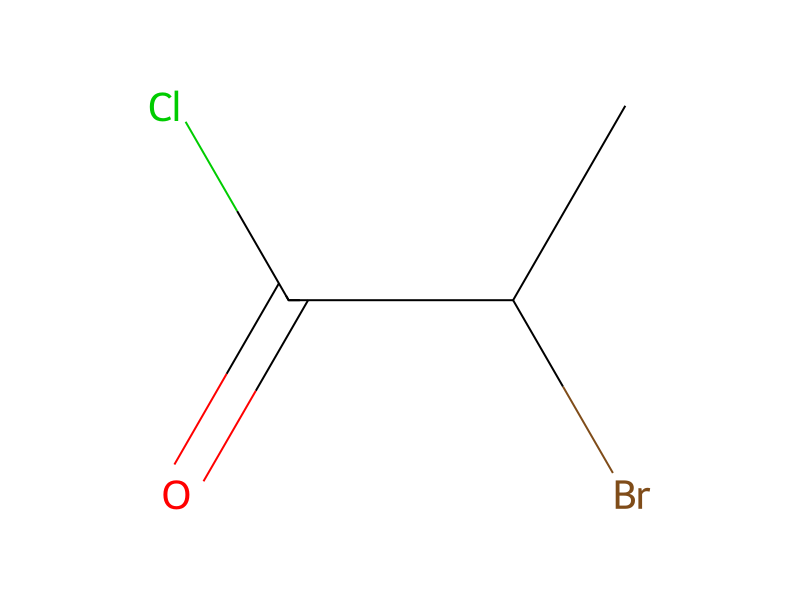
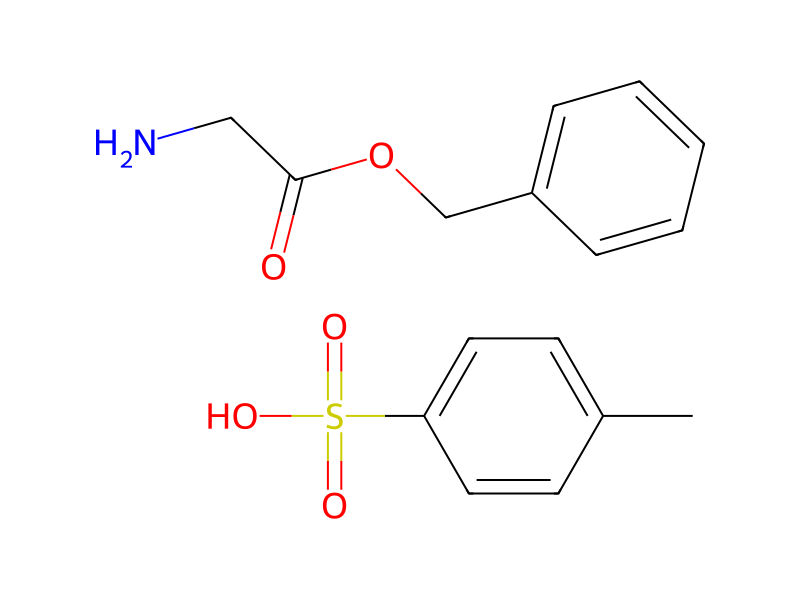
[Br:1][CH:2]([CH3:6])[C:3](Cl)=[O:4].C1(C)C=CC(S(O)(=O)=O)=CC=1.[CH2:18]([O:25][C:26](=[O:29])[CH2:27][NH2:28])[C:19]1[CH:24]=[CH:23][CH:22]=[CH:21][CH:20]=1.C(N(CC)CC)C.Cl>C(Cl)Cl.O>[CH2:18]([O:25][C:26](=[O:29])[CH2:27][NH:28][C:3](=[O:4])[CH:2]([Br:1])[CH3:6])[C:19]1[CH:24]=[CH:23][CH:22]=[CH:21][CH:20]=1Participants
7





Conditions
- Temperature
- 0 °C
Procedure
55.9 g (326.1 mmol) of 2-bromopropionic acid chloride is added in drops at 0° C. to 100 g (296.4 mmol) of glycine benzyl ester-p-toluenesulfonic acid salt and 33.0 g (326.1 mmol) of triethylamine in 400 ml of methylene chloride. The temperature is not allowed to exceed 5° C. After addition is completed, it is stirred for one hour at 0° C., then for 2 hours at room temperature. 500 ml of ice water is added, and the water phase is set at pH 2 with 10% aqueous hydrochloric acid. The organic phase is separated, washed once each with 300 ml of 5% aqueous soda solution and 400 ml of water. The organic phase is dried on magnesium sulfate and evaporated to dryness in a vacuum. The residue recrystallizes from diisopropyl ether.
Workup
- customto exceed 5° C
- additionAfter addition
- waitfor 2 hours at room temperature
- customThe organic phase is separated
- washwashed once each with 300 ml of 5% aqueous soda solution and 400 ml of water
- customThe organic phase is dried on magnesium sulfate
- customevaporated to dryness in a vacuum
- customThe residue recrystallizes from diisopropyl ether
Sources & evidence
- ORD record
- ord-05ceaa7221a1471ba0a200423d7fc5c6
- Source dataset
- uspto-grants-1998_10
- Patent number
- US05820849
Linked notes
Loading…