HomeMCPWorkbenchSkills
HomeWorkbenchNotificationsMe
llms.txt · MCP GuidePrivacy Policy · Terms of Service · Supportv1.8.3
  1. Home
  2. /Reaction

Potassium Carbonate → 4-cyclopropyl-1-isopropyl-1H-indole-3-carbaldehyde

HRID 402845
Print

Reaction equation

HRID 402845 reaction equation
Br[C:2]1[CH:10]=[CH:9][CH:8]=[C:7]2[C:3]=1[C:4]([CH:14]=[O:15])=[CH:5][N:6]2[CH:11]([CH3:13])[CH3:12].[CH:16]1(B(O)O)[CH2:18][CH2:17]1.C(=O)([O-])[O-].[K+].[K+]>O1CCOCC1.O.CC(P(C(C)(C)C)[C]1[CH][CH][CH][CH]1)(C)C.CC(P(C(C)(C)C)[C]1[CH][CH][CH][CH]1)(C)C.Cl[Pd]Cl.[Fe]>[CH:16]1([C:2]2[CH:10]=[CH:9][CH:8]=[C:7]3[C:3]=2[C:4]([CH:14]=[O:15])=[CH:5][N:6]3[CH:11]([CH3:13])[CH3:12])[CH2:18][CH2:17]1
ParticipantsConditionsProcedureWorkupSources & evidenceReaction notes

Participants

7

Reactant 3

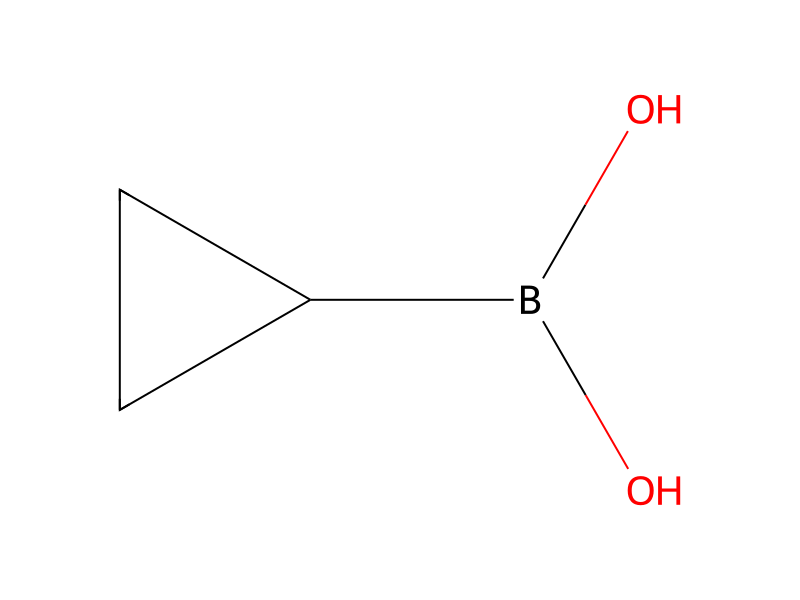
HCID 11430Potassium CarbonateHCID 2760897Cyclopropylboronic acidHCID 772308814-bromo-1-isopropyl-1H-indole-3-carbaldehyde

Product 1

HCID 772308774-cyclopropyl-1-isopropyl-1H-indole-3-carbaldehydeYield 18.5%

Reagents, catalysts & solvents 3

HCID 178454869
HCID 178454869, compound
Catalyst
HCID 962WaterSolvent
HCID 312751,4-DioxaneSolvent

Conditions

Temperature
140 °C

Procedure

To a solution of 4-romo-1-(propan-2-yl)-1H-indole-3-carboxaldehyde (120 mg, 0.451 mmol) (from Example 9-1, Step 1) and cyclopropylboronic acid (77 mg, 0.902 mmol) in dioxane (2 mL) and water (0.5 mL) in a 5 mL microwave reaction vial was added potassium carbonate (187 mg, 1.35 mmol) and dichloro[1,1′-bis(di-t-butylphosphino)ferrocene]palladium (II) (29 mg, 0.045 mmol). The reaction was placed under nitrogen, sealed and heated in a microwave reactor at 140° C. for 25 minutes. The solvent was removed in vacuo and the residue was partitioned with ethyl acetate and aqueous sodium bicarbonate and extracted twice with ethyl acetate. The organic layers were washed with brine, dried over sodium sulfate, filtered and concentrated. The residue was purified on silica gel (COMBI FLASH 24 gm column, gradient of 0-100% ethyl acetate/hexanes) to give the title intermediate (19 mg).

Workup

  1. customsealed
  2. customThe solvent was removed in vacuo
  3. customthe residue was partitioned with ethyl acetate and aqueous sodium bicarbonate
  4. extractionextracted twice with ethyl acetate
  5. washThe organic layers were washed with brine
  6. dry with materialdried over sodium sulfate
  7. filtrationfiltered
  8. concentrationconcentrated
  9. customThe residue was purified on silica gel (COMBI FLASH 24 gm column, gradient of 0-100% ethyl acetate/hexanes)

Sources & evidence

ORD record
ord-c464cef29b1846db90279fe2d76f9849
Source dataset
uspto-grants-2014_06
DOI
10.6084/m9.figshare.5104873.v1
Patent number
US08742110B2

Reaction notes

On this pageParticipantsConditionsProcedureWorkupSources & evidenceReaction notes