Reaction equation
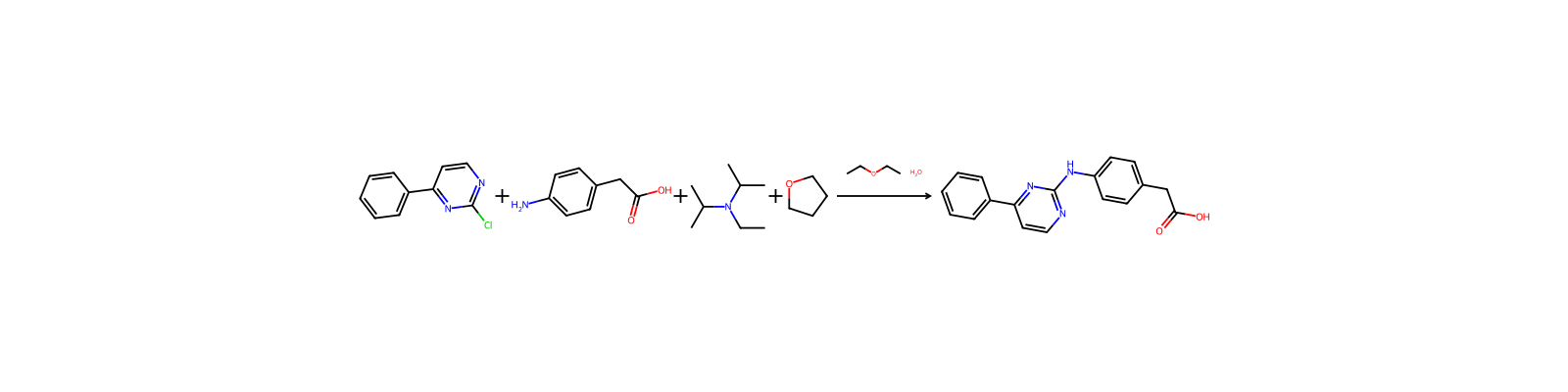
Cl[C:2]1[N:7]=[C:6]([C:8]2[CH:13]=[CH:12][CH:11]=[CH:10][CH:9]=2)[CH:5]=[CH:4][N:3]=1.[NH2:14][C:15]1[CH:20]=[CH:19][C:18]([CH2:21][C:22]([OH:24])=[O:23])=[CH:17][CH:16]=1.C(N(C(C)C)CC)(C)C.C1COCC1>CCOCC.O>[C:8]1([C:6]2[CH:5]=[CH:4][N:3]=[C:2]([NH:14][C:15]3[CH:16]=[CH:17][C:18]([CH2:21][C:22]([OH:24])=[O:23])=[CH:19][CH:20]=3)[N:7]=2)[CH:13]=[CH:12][CH:11]=[CH:10][CH:9]=1Participants
7
Reactant 4




Product 1

Reagents, catalysts & solvents 2


Conditions
- Temperature
- 160 °C
Procedure
A mixture of 2-chloro-4-phenylpyrimidine (0.19 g, 1.0 mmol), 2-(4-aminophenyl)acetic acid (0.38 g, 2.5 mmol), diisopropylethylamine (0.38 mL, 2.0 mmol), THF (3.0 mL) and water (1.0 mL) was placed in a seal tube and heated up to 160° C. in a microwave (Biotage, Model: Initiator) for 10 h. The reaction mixture was diluted with ether and washed with brine. The organic layer was separated, dried (MgSO4), and concentrated to afford 2-(4-(4-phenylpyrimidin-2-ylamino)phenyl)acetic acid in 77% yield. MS (ESI) 306 (M+H).
Workup
- customwas placed in a seal tube
- washwashed with brine
- customThe organic layer was separated
- dry with materialdried (MgSO4)
- concentrationconcentrated
Sources & evidence
- ORD record
- ord-931bd109fc354f99b71d1ec0d6a0dda9
- Source dataset
- uspto-grants-2013_09
- Patent number
- US08530480B2
Linked notes
Loading…