Reaction equation

C([NH:19]CC(O)CN1CCN(CC(O)CNCCCCCCCCC=CCCCCCCCC)CC1)CCCCCCCC=CCCCCCCCC.BrCCC[N:57]1[C:61](=[O:62])[C:60]2=[CH:63][CH:64]=[CH:65][CH:66]=[C:59]2[C:58]1=[O:67].C(N(C(C)C)CC)(C)C>CN(C=O)C.C(Cl)(Cl)Cl>[C:58]([NH2:19])(=[O:67])[C:59]1[C:60](=[CH:63][CH:64]=[CH:65][CH:66]=1)[C:61]([NH2:57])=[O:62]Participants
Reactant 3
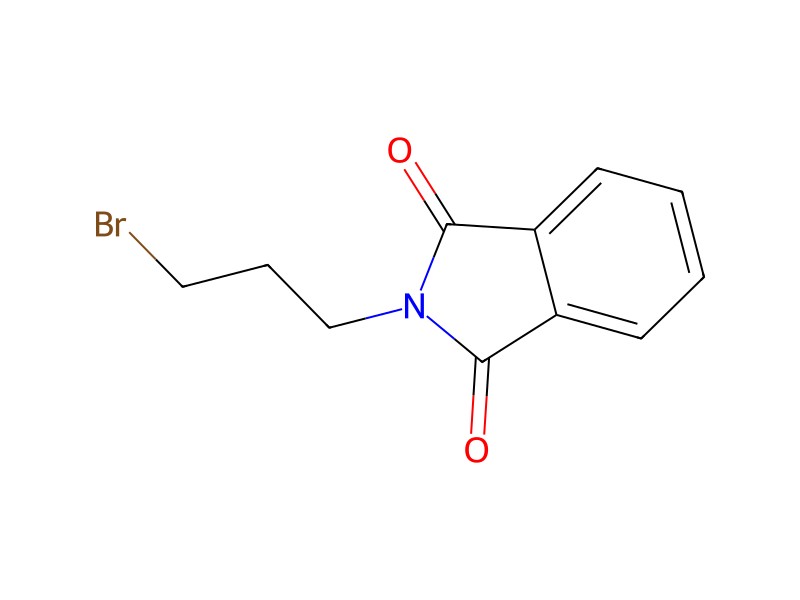


Product 1

Reagents, catalysts & solvents 2


Conditions
- Temperature
- 100 °C
Procedure
Compound 3 (2.5 g) was treated with N-(3-bromopropyl)phthalimide (2.19 g) and diisopropylethylamine (2 ml) in DMF (10 ml). The reaction mixture was heated at 100° C. for 3 hours and then diluted with chloroform (300 ml) and extracted with water (4×300 ml). The chloroform was removed on a rotary evaporator and the residue subjected to flash chromatography using chloroform and methanol/chloroform as eluants to obtain the desired phthlamide adduct (Compound 4). Hydrazine hydrate (0.75 ml) was added to a solution of the phthalimide compound 4 (1.7 g) in 100% reagent alcohol (100 ml). The reaction mix was refluxed overnight and cooled to room temperature for about 1 hr. The reaction mix was then cooled at 4° C. overnight and the precipitate obtained by filtration. The solid was washed with ethanol chilled to −20° C. (2×20 ml) and dried in vacuo. The residue was dissolved in chloroform (300 ml), filtered and extracted twice with water (200 ml). The chloroform was removed on a rotary evaporator to give 1,4-Bis[(3-(3-aminopropyl)-oleoylamino)-2-hydroxypropyl]piperazine (Compound 5) in a quantitative yield. This material was acidified with HCL in dioxane and purified on reverse phase (C-18) flash chromatography using aqueous methanol as eluant and characterized by TLC and mass spectrometry.
Workup
- extractionextracted with water (4×300 ml)
- customThe chloroform was removed on a rotary evaporator
Sources & evidence
- ORD record
- ord-7ef7974b8cb6481397615f6173bdfa91
- Source dataset
- uspto-grants-2014_06
- Patent number
- US08759499B2
Linked notes
Loading…