HomeMCPWorkbenchSkills
HomeWorkbenchNotificationsMe
llms.txt · MCP GuidePrivacy Policy · Terms of Service · Supportv1.8.2
  1. Home
  2. /Reaction

Naphthacene → 5-Naphthacenecarboxaldehyde

HRID 414400
Print

Reaction equation

HRID 414400 reaction equation
CN([CH:9]=[O:10])C1C=CC=CC=1.P(Cl)(Cl)(Cl)=O.[CH:16]1[C:33]2[C:20](=[CH:21][C:22]3[C:31]([CH:32]=2)=[CH:30][C:29]2[C:24](=[CH:25][CH:26]=[CH:27][CH:28]=2)[CH:23]=3)[CH:19]=[CH:18][CH:17]=1>ClC1C=CC=CC=1Cl>[CH:19]1[C:20]2[C:33](=[C:32]([CH:9]=[O:10])[C:31]3[C:22]([CH:21]=2)=[CH:23][C:24]2[C:29](=[CH:28][CH:27]=[CH:26][CH:25]=2)[CH:30]=3)[CH:16]=[CH:17][CH:18]=1
ParticipantsProcedureWorkupSources & evidenceReaction notes

Participants

5

Reactant 3

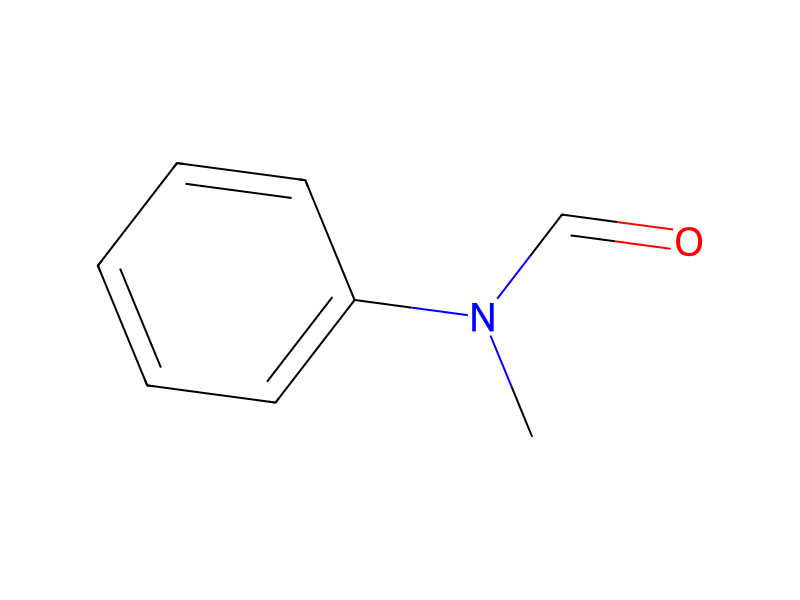
HCID 7080NaphthaceneHCID 24813Phosphorus oxychlorideHCID 66737N-Methylformanilide

Product 1

HCID 111495315-NaphthacenecarboxaldehydeYield 31.1%

Reagents, catalysts & solvents 1

HCID 72391,2-DichlorobenzeneSolvent

Procedure

To a 3-necked RB flask equipped with overhead mechanical stirrer, condenser, addition funnel, N2 inlet line with bubbler was added N-methylformanilide (Aldrich, 89.21 g, 0.66 mol, 81 mL) and o-dichlorobenzene (Aldrich, 200 mL). The mixture was cooled to 10° with an ice bath. Phosphorus oxychloride (Aldrich, 101.21 g, 0.66 mol, 60 mL) was then added dropwise to the solution not allowing the reaction temperature to rise above 10°. The reaction mixture was then allowed to warm to RT. Solid naphthacene (Cambridge Chemical, Inc., 50 g, 0.22 mol) was then added in five portions over 5 min. The reaction mixture was warmed slowly to 80° (the mixture turns from purple to an almost black color). The reaction was stirred at 80° for 12 h, cooled, poured into ice water (2 L) and stirred an additional 12 h at RT. The mixture was then filtered. The organic layer in the filtrate was dried (Na2SO4) and applied to a plug of SiO2 (500 g) and eluted first with PhCH3 followed by CH2Cl2. The appropriate fractions were combined and the solvent removed by rotary evaporation. Recrystallization (CH2Cl2 /EtOAc) gave 17.5 g (31.1% yield) of naphthacene-5-carbaldehyde, mp 163°-164° (Lit. 164°, N. P. Buu-Hoi et al., Recueil 76 674 (1957)), (C, H). The solid from the filtration of the crude reaction mixture was washed with a large volume of CH3OH (5×200 mL), dissolved in THF (4 L) and passed through a plug of SiO2 (500 g) using an additional 2 L of THF as eluting solvent. The solvent was reduced to a volume of 300 mL and then diluted to 800 mL with EtOAc. The solvent volume was reduced to 250 mL. After filtration and drying 10.90 g (17.4% yield) of naphthacene-5,11-dicarbaldehyde, mp 247°-250°, (C, H).

Workup

  1. customTo a 3-necked RB flask equipped with overhead mechanical stirrer, condenser, addition funnel, N2 inlet line with bubbler
  2. temperatureThe mixture was cooled to 10° with an ice bath
  3. customto rise above 10°
  4. temperatureThe reaction mixture was warmed slowly to 80° (the mixture
  5. temperaturecooled
  6. stirringstirred an additional 12 h at RT
  7. filtrationThe mixture was then filtered
  8. dry with materialThe organic layer in the filtrate was dried (Na2SO4)
  9. washeluted first with PhCH3
  10. customthe solvent removed by rotary evaporation
  11. customRecrystallization (CH2Cl2 /EtOAc)

Sources & evidence

ORD record
ord-cda5677ef34349548181b930ad22a1bb
Source dataset
uspto-grants-1988_12
DOI
10.6084/m9.figshare.5104873.v1
Patent number
US04791232

Reaction notes

On this pageParticipantsProcedureWorkupSources & evidenceReaction notes